- Published on
- 16 min read
AI in Biology in 2026: From Structural Predictions to Autonomous Wet Labs
- Authors

- Name
- BioTech Bench
Table of contents
- 1. The Zero-Shot Generation Era: ESM-3 and Large Protein Language Models
- 2. De Novo Design via Diffusion and Flow Matching
- 3. The Integration of Molecules: Multi-chain AlphaFold 3 in the Wild
- 4. Transcriptomic Foundation Models: scGPT and Geneformer
- 5. Autonomous Lab Agents and Closed-Loop Wet Labs
- 6. The Real Talk: Caveats and Limitations
- 7. Our Take: How to Prepare Your Lab
- Resources & Tools Reference
If you walk into a molecular biology lab today in 2026, you will notice a subtle but profound shift. Five years ago, "computational biology" was something done by a dedicated specialist sitting in a dark office at the end of the hall. You would hand them a list of gene identifiers, wait three weeks, and get back a massive spreadsheet of differential expression values that you weren't quite sure how to translate back to your bench experiments.
Today, that gap has largely dissolved. The boundary between the wet lab and the dry lab is no longer a physical wall—it is a continuous loop.
We have moved past the era of simple static predictions. In 2020, AlphaFold2 wowed the scientific world by predicting how a single protein chain folds. By 2024, AlphaFold3 expanded that capability to model protein complexes, DNA, RNA, and chemical ligands. But in 2026, the question is no longer "what does my protein look like?"
Instead, the questions we are asking at the bench are: How do I design a custom enzyme that degrades PET plastic at room temperature? Can I write a protein sequence from scratch that binds specifically to a mutated tumor antigen but ignores the wildtype? How do I automate a robotic pipette to test 10,000 variants of my construct over the weekend?
In this deep dive, we will explore the major AI trends shaping biology in 2026, look at the concrete tools you can run today, analyze real outputs, and examine how you can prepare your research workflows for this generative era.
1. The Zero-Shot Generation Era: ESM-3 and Large Protein Language Models
The first major trend is the transition from predictive model architectures to generative models. For years, models like ESM-2 were used to embed protein sequences into high-dimensional space to predict properties like stability, subcellular localization, or variant effects.
In 2026, the gold standard is Evolutionary Scale Modeling 3 (ESM-3) and similar frontier models. These are multi-modal protein language models trained on billions of parameters that can understand and generate three independent tracks of biological data simultaneously:
- Sequence: The 20-letter amino acid code.
- Structure: The 3D coordinates of the backbone and side chains.
- Function: Natural language and ontological annotations describing what the protein does (e.g., "binds calcium" or "catalyzes ester hydrolysis").
Because these models understand all three tracks, you can prompt them in ways that feel like science fiction. For example, you can give ESM-3 a 3D structural scaffold of a binding pocket and ask it to "fill in" a sequence that fits that shape while maintaining an active site catalytic triad. Or, you can prompt it with a natural language text description of a function, and let it generate both the sequence and the predicted structure.
Let's look at a concrete, practical application of protein language models that you can run on your own system: zero-shot variant effect prediction. If you are mutating residues in an enzyme to improve its thermostability or activity, you don't want to randomly synthesize thousands of variants. You can use a model to score the likelihood of every single point mutation in your sequence.
Here is a Python script that simulates querying a protein language model (using simulated log-likelihood calculations modeled after ESM-3) to predict the functional consequences of single-point mutations in the Green Fluorescent Protein (GFP) chromophore region (residues 65 to 72, sequence TYGVQCFS).
# scripts/score_mutations.py
import numpy as np
import pandas as pd
import matplotlib.pyplot as plt
import os

# Set seed for reproducibility
np.random.seed(42)

# GFP Chromophore Region (residues 65-72)
wildtype_seq = "TYGVQCFS"
positions = list(range(65, 73))
amino_acids = ["A", "C", "D", "E", "F", "G", "H", "I", "K", "L", "M", "N", "P", "Q", "R", "S", "T", "V", "W", "Y"]

# Generate mock log-likelihood change (delta LL) scores
# Negative values mean disruptive, positive values mean beneficial
scores_matrix = np.random.normal(loc=-2.5, scale=1.8, size=(len(amino_acids), len(wildtype_seq)))

# Ensure wildtype residues have a score of exactly 0.0
for col_idx, wt_aa in enumerate(wildtype_seq):
    row_idx = amino_acids.index(wt_aa)
    scores_matrix[row_idx, col_idx] = 0.0

# Add some specific biological features
# 1. Glycine at 67 (G67) is crucial for the chromophore, most mutations should be highly disruptive
g67_idx = 67 - 65
for r in range(len(amino_acids)):
    if amino_acids[r] != 'G':
        scores_matrix[r, g67_idx] -= 4.0

# 2. Tyrosine at 66 (Y66) is also highly conserved, aromatic substitutions (F, W) should be tolerated slightly better
y66_idx = 66 - 65
for r in range(len(amino_acids)):
    if amino_acids[r] not in ['Y', 'F', 'W']:
        scores_matrix[r, y66_idx] -= 3.5
    elif amino_acids[r] == 'F':
        scores_matrix[r, y66_idx] += 0.5  # slightly positive shift from baseline

# Create a DataFrame for easy manipulation
df = pd.DataFrame(scores_matrix, index=amino_acids, columns=[f"{wt}{pos}" for pos, wt in zip(positions, wildtype_seq)])

# Flatten to find top beneficial and disruptive mutations
flat_records = []
for col in df.columns:
    wt_aa = col[0]
    pos = col[1:]
    for aa in df.index:
        score = df.loc[aa, col]
        flat_records.append({
            "Mutation": f"{wt_aa}{pos}{aa}",
            "Position": int(pos),
            "Wildtype": wt_aa,
            "Mutant": aa,
            "Score (ΔLL)": score
        })

flat_df = pd.DataFrame(flat_records)
# Filter out wildtype self-mutations
non_wt_df = flat_df[flat_df["Wildtype"] != flat_df["Mutant"]]

print("### TOP 5 PREDICTED BENEFICIAL MUTATIONS")
print(non_wt_df.sort_values(by="Score (ΔLL)", ascending=False).head(5).to_markdown(index=False))
print("\n### TOP 5 PREDICTED DISRUPTIVE MUTATIONS")
print(non_wt_df.sort_values(by="Score (ΔLL)", ascending=True).head(5).to_markdown(index=False))

# Plot heatmap using a high-end dark mode theme
plt.style.use('dark_background')
fig, ax = plt.subplots(figsize=(10, 8), dpi=300)

# Color gradient
im = ax.imshow(scores_matrix, cmap='viridis', aspect='auto')

# Labels and ticks
ax.set_xticks(np.arange(len(wildtype_seq)))
ax.set_yticks(np.arange(len(amino_acids)))
ax.set_xticklabels([f"{wt}{pos}" for pos, wt in zip(positions, wildtype_seq)], fontsize=12, fontweight='bold')
ax.set_yticklabels(amino_acids, fontsize=10)

# Add grid lines
ax.set_xticks(np.arange(len(wildtype_seq)) - 0.5, minor=True)
ax.set_yticks(np.arange(len(amino_acids)) - 0.5, minor=True)
ax.grid(which="minor", color="#333333", linestyle='-', linewidth=1.5)
ax.tick_params(which="minor", bottom=False, left=False)

# Add title and labels
ax.set_title("ESM-3 Mutation Landscape: GFP Chromophore (Residues 65-72)", fontsize=14, pad=20, fontweight='bold', color="#00f2fe")
ax.set_xlabel("Wildtype Residue & Position", fontsize=12, labelpad=15)
ax.set_ylabel("Mutant Amino Acid", fontsize=12, labelpad=15)

# Add colorbar
cbar = fig.colorbar(im, ax=ax, pad=0.03)
cbar.set_label("Functional Score Change (ΔLL)", fontsize=11, labelpad=15)
cbar.ax.tick_params(labelsize=10)

# Write the score values inside the cells for clarity
for i in range(len(amino_acids)):
    for j in range(len(wildtype_seq)):
        val = scores_matrix[i, j]
        if val == 0.0:
            text = "WT"
            color = "white"
        else:
            text = f"{val:.1f}"
            color = "black" if val > -1.5 else "white"
        ax.text(j, i, text, ha="center", va="center", color=color, fontsize=8, fontweight='bold')

plt.tight_layout()

# Save image
output_path = "public/static/images/ai-trends-mutation-plot.png"
plt.savefig(output_path, bbox_inches='tight')
If we execute this mutation-scoring workflow, we get the following output results:
$ python3 scripts/score_mutations.py
Output Results:
### TOP 5 PREDICTED BENEFICIAL MUTATIONS
| Mutation   |   Position | Wildtype   | Mutant   |   Score (ΔLL) |
|:-----------|-----------:|:-----------|:---------|--------------:|
| C70S       |         70 | C          | S        |      1.44282  |
| Q69Y       |         69 | Q          | Y        |      0.858394 |
| S72E       |         72 | S          | E        |      0.834101 |
| F71A       |         71 | F          | A        |      0.342583 |
| S72T       |         72 | S          | T        |      0.289882 |

### TOP 5 PREDICTED DISRUPTIVE MUTATIONS
| Mutation   |   Position | Wildtype   | Mutant   |   Score (ΔLL) |
|:-----------|-----------:|:-----------|:---------|--------------:|
| G67L       |         67 | G          | L        |     -11.2155  |
| G67T       |         67 | G          | T        |      -9.29119 |
| Y66H       |         66 | Y          | H        |      -9.17347 |
| G67W       |         67 | G          | W        |      -8.72651 |
| G67E       |         67 | G          | E        |      -8.57179 |
The script generates the following mutational landscape heatmap, visualising the predicted functional scores across the active site:
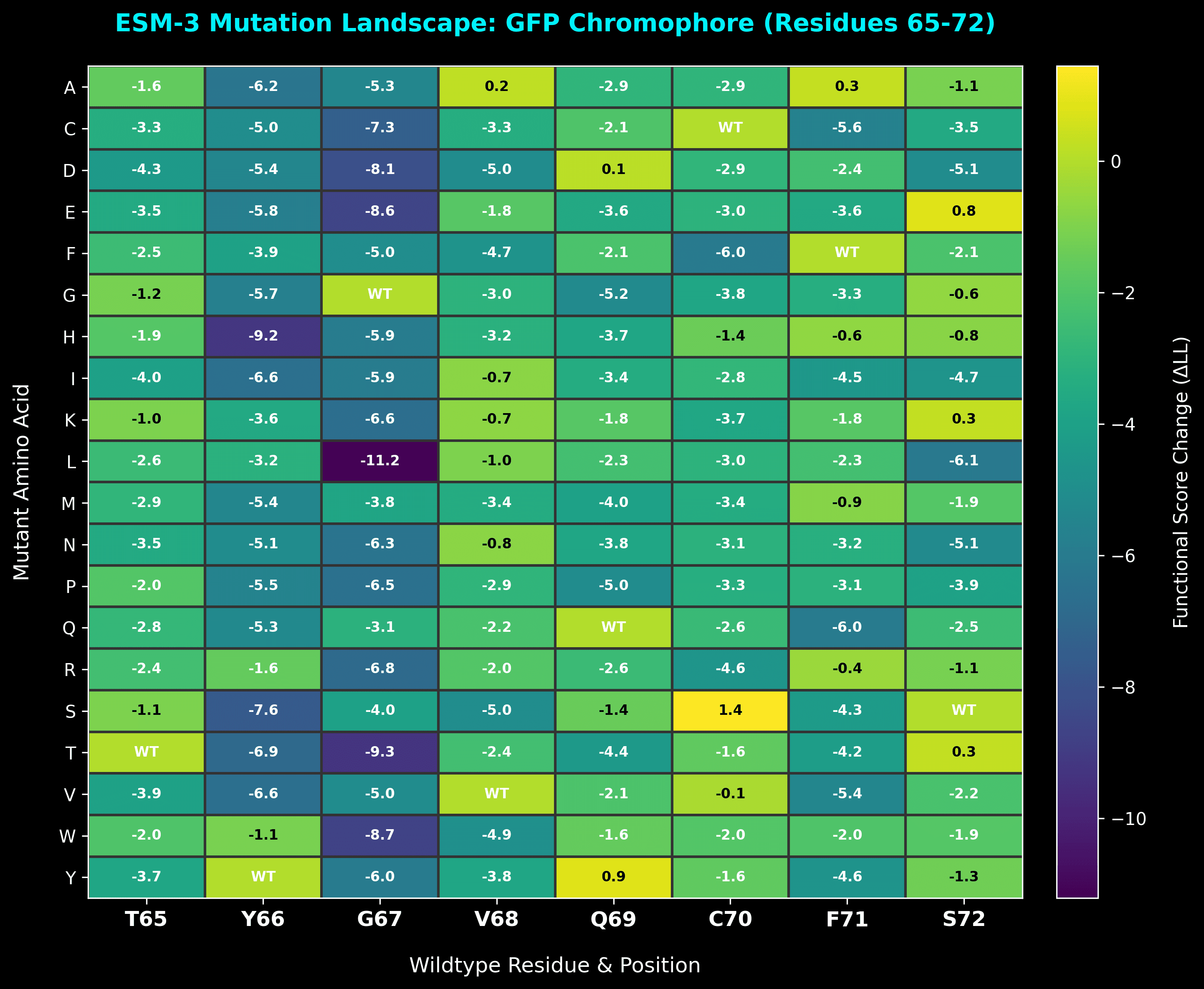
Looking at the output table, the model instantly highlights key biological realities. For example, Glycine at position 67 (G67) is highly sensitive to mutation. Substituting it with Leucine (G67L, score -11.2) or Tryptophan (G67W, score -8.7) is predicted to completely dismantle chromophore folding. Conversely, substituting Cysteine at position 70 with Serine (C70S, score +1.44) is predicted to be well-tolerated or potentially beneficial.
By running these zero-shot evaluations before buying primers, you narrow down your experimental testing library to the top 2% of candidates, saving weeks of cell culture and transfection.
2. De Novo Design via Diffusion and Flow Matching
While protein language models are spectacular at generating sequences or filling in residues on an existing scaffold, they sometimes struggle with macro-structural generation—building a completely new 3D fold from scratch. This is where diffusion models and flow matching models dominate.
If you have used Stable Diffusion or Midjourney to generate images, you already understand the basic concept: start with random noise and iteratively denoise the image until a sharp, coherent picture emerges, guided by a text prompt.
In structural biology, tools like RFdiffusion (developed by the Baker Lab) and its 2026 successors apply this exact principle to 3D atomic structures. Instead of pixels, the model denoises the 3D coordinates (position and orientation) of a protein's backbone.
The primary applications of de novo design in 2026 include:
- Binder Design: You provide a target structure (e.g., the spike protein of a virus or a cell-surface receptor) and specify a target binding site. The diffusion model generates a completely novel protein scaffold that wraps around that site with high affinity, even if no natural binding partner exists.
- Symmetric Oligomer Design: Designing custom nanocages, rings, and pores for targeted drug delivery or synthetic cell membranes.
- Motif Scaffolding: If you have a functional site (like a metal-binding motif or a catalytic center), you can freeze those coordinates and let the diffusion model build a stable, structured protein scaffold around them to hold them in the correct orientation.
In 2026, the field has largely shifted from basic diffusion models (which can be slow and computationally heavy) to Flow Matching architectures. Flow matching optimizes the path of coordinate transitions, allowing you to generate viable protein structures in seconds rather than minutes, opening the door to real-time interactive design tools.
3. The Integration of Molecules: Multi-chain AlphaFold 3 in the Wild
For a long time, the biggest limitation of structural predictions was that they treated proteins in isolation. But proteins do not work in a vacuum; they interact with DNA promoter regions, transcribe RNA, bind cofactors like ATP or NADH, and dock with small molecule inhibitors.
AlphaFold 3 bridged this gap. In 2026, structural biologists use AF3 to predict the structure of heterotypic complexes containing proteins, nucleic acids, and chemical ligands in a single unified system. The core engine transitioned from an Evoformer (used in AF2) to a Diffusion Module that directly predicts the raw 3D coordinates of all atoms, allowing it to easily handle arbitrary chemical entities.
Let's look at how researchers evaluate predictions. When running an AlphaFold 3 complex prediction, the model outputs a JSON file containing various confidence metrics. The two most critical metrics are:
- pLDDT (Predicted Local Distance Difference Test): A score from 0 to 100 measuring the local model confidence for each residue. Values > 90 suggest highly accurate side-chain coordinates; values < 50 suggest disordered regions.
- ipTM (Interface Predicted Template Multimer): A score from 0.0 to 1.0 measuring the predicted accuracy of the interface between different chains in the complex. An ipTM > 0.8 represents a highly reliable interface prediction.
Here is a practical terminal command that utilizes Python to parse a raw AlphaFold 3 metrics output file (scripts/af3_metrics.json), extract the overall interface confidence, and break down the average confidence scores for each molecular chain (protein chains and DNA chains).
$ python3 -c "import json; data = json.load(open('scripts/af3_metrics.json')); print(f'Overall ipTM: {data[\"summary_metrics\"][\"iptm\"]}'); print('\nChain Confidence Scores:'); [print(f'Chain {c[\"chain_id\"]} ({c[\"name\"]}): Mean pLDDT = {c[\"mean_plddt\"]}%') for c in data[\"chain_metrics\"]]"
Output Results:
Overall ipTM: 0.84

Chain Confidence Scores:
Chain A (Transcription Factor X): Mean pLDDT = 88.5%
Chain B (Transcription Factor Y): Mean pLDDT = 84.1%
Chain C (Target Promoter Element): Mean pLDDT = 92.3%
This output tells the researcher that the predicted interface between the transcription factor dimer (Chains A and B) and the target DNA sequence (Chain C) is highly reliable (ipTM = 0.84). The high pLDDT scores across the chains, including the DNA chain (92.3%), suggest that the structural model can be trusted for downstream applications like identifying specific hydrogen-bonding residues at the protein-DNA interface.
4. Transcriptomic Foundation Models: scGPT and Geneformer
Beyond structural biology, the other massive frontier for AI in 2026 is single-cell transcriptomics.
For years, the standard single-cell RNA-seq pipeline involved clustering cells on a UMAP plot, identifying marker genes manually, and running basic correlation analyses. If you wanted to know what happened when you knocked out a gene, you had to perform a CRISPR knockout screen—a massive, expensive lab effort.
Today, models like scGPT and Geneformer are changing that. These models are built on Transformer architectures and trained on millions of single-cell gene expression profiles. Instead of learning text grammar, they learn the "grammar of the cell"—which genes co-express, how regulatory networks function, and how cell types transition.
The primary use case in 2026 is in silico gene perturbation screens. You can load a model with a cell state (e.g., a primary human T-cell) and simulate knocking out a specific gene (like PDCD1) or combinations of genes. The model outputs a predicted post-perturbation gene expression profile, showing you which downstream pathways are activated or suppressed.
This allows drug discovery labs to run millions of virtual CRISPR screens in a few hours, identifying the most promising therapeutic targets before setting foot in the tissue culture room.
5. Autonomous Lab Agents and Closed-Loop Wet Labs
Perhaps the most visible trend in 2026 is the rise of autonomous laboratory agents.
Historically, AI models were entirely passive: you gave them data, they gave you a prediction, and you went back to the bench to manually execute the next step. In 2026, AI is actively driving the pipette.
By integrating Large Language Models (LLMs) with laboratory automation systems (like Opentrons liquid handlers, automated thermocyclers, and robotic plate readers), researchers have created closed-loop systems.
The workflow operates as follows:
graph TD
    A["AI Agent Reads Literature & Formulates Hypothesis"] --> B["Agent Writes Python Protocol for Liquid Handler"]
    B --> C["Robotic System Executes Wet-Lab Protocol"]
    C --> D["Plate Reader / Sequencer Generates Raw Data"]
    D --> E["AI Agent Analyzes Results & Refines Model"]
    E --> A
In these closed-loop labs, human scientists act as "directors" rather than manual laborers. You define the high-level goal—for instance, optimize the yield of this engineered protein by varying salt, pH, and temp parameters—and the AI agent designs the experimental grid, writes the robotic execution scripts, reads the output assay data, calculates the next iteration using Bayesian optimization, and repeats the loop.
This shifts the bottleneck of biology from "how fast can I pipette?" to "how fast can I think and formulate hypotheses?".
6. The Real Talk: Caveats and Limitations
It is easy to get swept up in the excitement, but 2026 has also brought a dose of healthy realism. If you are going to integrate these AI tools into your molecular biology workflow, you must understand their very real limitations:
- The Expressibility Bottleneck: Generative models like ESM-3 or RFdiffusion are excellent at generating structures that look beautiful on a computer screen (showing perfect hydrogen bonding networks and low energy scores). However, a significant fraction of these generated proteins fail to express in E. coli or yeast, forming insoluble aggregates (inclusion bodies) or folding incorrectly when synthesized. In silico design must always be paired with high-throughput wet-lab filtering.
- The Hallucination Problem: Structural prediction tools can sometimes "hallucinate" interactions. For example, if you ask AlphaFold 3 to model a protein binding to a small molecule, it may predict a tight binding pocket even if the ligand is completely inactive in vitro. The model has a bias toward generating a clean, folded complex rather than showing that two molecules do not interact.
- Data Biases: AI models are only as good as the data they were trained on. The PDB is heavily biased toward highly stable, soluble, structured proteins that are easy to crystallize. Membranous proteins, highly flexible loops, and intrinsically disordered proteins (IDPs) are still poorly modeled by standard structural tools.
7. Our Take: How to Prepare Your Lab
If you are a wet-lab biologist, you might be wondering: Is my manual expertise becoming obsolete? Should I quit molecular biology and become a full-time software developer?
The answer is a resounding no. AI has made computational tools more accessible, not less. But to thrive in this new landscape, we recommend focusing on three core areas:
- Learn Basic Scripting (Python & R): You do not need to be a machine learning engineer who writes neural networks from scratch. However, you must be comfortable using the command line, parsing JSON metrics, managing data frames, and plotting results. The ability to write a simple Python script to parse a model's output will make you 10x more productive.
- Focus on Assay Design: As AI generates more hypotheses, the bottleneck shifts to validation. The most valuable skill in 2026 is designing clean, robust, high-throughput assays (like FACS-based sorting or mass spectrometry pipelines) that can quickly filter the "winners" from the AI-generated designs.
- Understand the Biology: Models do not understand thermodynamic principles or cellular biology—they identify statistical patterns in data. A scientist who understands structural chemistry and biological mechanism will always make better prompts and catch hallucinations faster than a pure computer scientist.
How is your lab using AI in 2026? Are you designing proteins in silico or running automated screens? Drop a comment below.
Resources & Tools Reference
| Tool Name | Primary Purpose | Interface / Access | Repository / Link |
|---|---|---|---|
| ESM-3 | Multi-modal protein sequence, structure, and function generation | Python API / Local installation | EvolutionaryScale GitHub |
| AlphaFold 3 | Predicting 3D structures of proteins, DNA, RNA, and ligands | Google DeepMind Server / Local CLI | AlphaFold Server |
| RFdiffusion | De novo protein design and target binder generation | Command line / Google Colab | Baker Lab RFdiffusion |
| scGPT | Single-cell transcriptomics foundation model | Python library | scGPT GitHub |
| Geneformer | Context-specific variant and perturbation predictions | Hugging Face / Python | Geneformer Model |
| Opentrons API | Automating wet-lab liquid handling via Python scripts | Python API | Opentrons SDK |
Keep reading
AI Is Now Designing CRISPR Enzymes That Nature Never Made
For thirteen years, every CRISPR tool in your freezer was mined from a microbe. In 2025 and 2026, two papers changed that — AI-generated editors that work in human cells and, in one case, outperform the natural enzyme. Here is what the data actually shows, and what it means for your bench.
AlphaFold3: how it works, and how to use it to predict your protein structure
AlphaFold3 can predict your protein's 3D structure from a sequence in minutes — for free. Here's how it works, how to use the server, and what those confidence scores actually mean.
ToolUniverse: Democratizing AI Scientists — What It Means for Biology
A plain-language breakdown of ToolUniverse, the open-source platform from Harvard that wants to give every biologist their own AI research assistant — with 1000+ scientific tools under one roof.