- Published on
- 10 min read
What is GLP-1? The biology behind Ozempic, Wegovy, and Mounjaro
- Authors

- Name
- BioTech Bench
- @BiotechBench
Table of contents
Ozempic is everywhere. It's on the news, in celebrity gossip columns, in the conversations your colleagues are having at the coffee machine. Politicians are debating NHS access to it. Late-night hosts are making jokes about it. Pharmaceutical company shares are moving on its sales figures.
But what is it actually doing? Not "it suppresses appetite" — that's the output. What is the mechanism? What's the molecule, where does it act, and why does a weekly injection of a synthetic peptide cause you to eat less, lose weight, and apparently also reduce your risk of a heart attack?
The biology here is genuinely interesting — and not complicated, once you get a few concepts in order.
What is GLP-1?
GLP-1 stands for glucagon-like peptide-1. It's a hormone your gut makes naturally, every time you eat.
It's produced by L-cells — specialised enteroendocrine cells scattered throughout the intestinal lining, particularly in the ileum and colon. When nutrients arrive in the small intestine, L-cells detect them and secrete GLP-1 into the bloodstream within minutes. The signal travels fast: GLP-1 levels start rising within 10–15 minutes of a meal and peak around 30–60 minutes.
GLP-1 belongs to a class called incretins — gut-derived hormones that enhance the insulin response to a meal. The incretin concept dates to the 1960s, when researchers noticed that glucose given orally triggered more insulin secretion than the same amount of glucose given intravenously. Something in the gut was amplifying the signal. GLP-1 (and its sibling hormone GIP) turned out to be the primary answer.
There's one catch. The body inactivates GLP-1 very quickly. An enzyme called DPP-4 (dipeptidyl peptidase-4), which is present throughout the bloodstream and on vascular endothelium, cleaves the N-terminus of GLP-1 and renders it biologically inactive. The half-life of native GLP-1 in circulation is roughly two minutes. It's a hormone built to act locally and briefly — a short pulse coordinating a meal response, not a prolonged signal.
GLP-1 is derived from proglucagon, a precursor protein encoded by a single gene. Depending on where proglucagon is cleaved, it produces different peptides: in the pancreatic alpha cells, it generates glucagon; in the intestinal L-cells and the brain, it generates GLP-1 and GLP-2. Same gene, completely different hormones, depending on which tissue is doing the processing.
How does it lower blood sugar?
GLP-1 acts primarily on the GLP-1 receptor (GLP-1R), a class B G-protein coupled receptor (GPCR) expressed in the pancreas, brain, gut, heart, and several other tissues.
In the pancreatic beta cell, the signalling cascade works like this: GLP-1 binds GLP-1R → the receptor couples to the Gs protein → Gs activates adenylyl cyclase → intracellular cAMP rises → cAMP activates PKA (protein kinase A) and the exchange protein EPAC2 → PKA phosphorylates proteins in the insulin secretion machinery, promoting the exocytosis of insulin-containing granules from the beta cell.
The critical feature: this effect is glucose-dependent. The cAMP pathway amplifies insulin secretion, but it doesn't trigger it independently. If blood glucose is low, there's no meaningful depolarisation of the beta cell, and GLP-1 signalling has little effect. This is why GLP-1 receptor agonists don't typically cause hypoglycaemia — they're potentiating a signal that only fires when glucose is actually elevated. That's a clinically important distinction from older insulin secretagogues like sulfonylureas, which push insulin secretion regardless of blood sugar level.
GLP-1 also suppresses glucagon release from pancreatic alpha cells, though the mechanism here is less direct — it may act partly via somatostatin from delta cells, and possibly through direct GLP-1R signalling on alpha cells. Lower glucagon means less hepatic glucose output, reinforcing the blood-sugar-lowering effect.
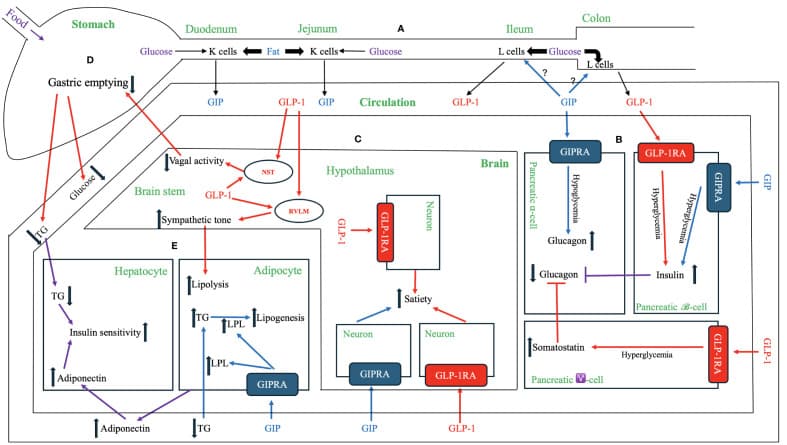
Figure 1. Overview of GLP-1 and GIP physiological actions across multiple tissue compartments, including pancreatic beta cells, brain, gut, and adipose tissue. Adapted from Liu QK (2024). Mechanisms of action and therapeutic applications of GLP-1 and dual GIP/GLP-1 receptor agonists. _Frontiers in Endocrinology, 15:1431292. doi:10.3389/fendo.2024.1431292, under CC BY 4.0._
How does it suppress appetite?
This is what most people are really asking about when they ask about Ozempic — and the answer lives in the brain, not the pancreas.
GLP-1 receptors are expressed in key appetite-regulating areas of the brain, including the hypothalamus (particularly the arcuate nucleus and paraventricular nucleus) and the brainstem (the nucleus tractus solitarius and area postrema). These regions integrate signals about energy status and control feeding behaviour.
When GLP-1 — or a long-acting GLP-1 receptor agonist — activates these receptors, it promotes satiety signals and reduces the drive to eat. You feel full sooner, you feel hungry less urgently, and food is often reported as less rewarding. This last point is notable: there are GLP-1 receptors in the mesolimbic dopamine system, including the ventral tegmental area and nucleus accumbens, suggesting that GLP-1 signalling may modulate the hedonic or "wanting" aspect of eating — not just the homeostatic "I need fuel" signal.
GLP-1 also acts on the vagus nerve. Vagal afferents in the gut carry satiety signals from the gut to the brainstem, and GLP-1 can act on GLP-1Rs on these nerves directly. The result is an enhanced "I've eaten enough" message being relayed from gut to brain.
A third mechanism: GLP-1 slows gastric emptying — the rate at which food moves from the stomach into the small intestine. This physical slowing of the digestive process prolongs the sensation of fullness after a meal and blunts the postprandial blood glucose spike.
These mechanisms work together, and they act on what's sometimes called the gut-brain axis — the bidirectional signalling network between the digestive system and the central nervous system that regulates everything from hunger to mood.
Why does a weekly injection work when your body makes GLP-1 constantly?
Your L-cells are already making GLP-1 every time you eat. So why does injecting a GLP-1 receptor agonist once a week cause such dramatic effects?
The answer is the DPP-4 problem. Native GLP-1 is gone within two minutes. It never reaches the brain in meaningful concentrations; its systemic effects are limited by its rapid inactivation. The drug developers' challenge was to make a molecule that activates GLP-1R but survives long enough to matter.
Semaglutide (the active ingredient in Ozempic and Wegovy) achieves this through two key modifications:
Position 8 substitution: In native GLP-1, the amino acid at position 8 is alanine — this is the DPP-4 cleavage site. Semaglutide replaces this alanine with Aib (α-aminoisobutyric acid), a non-natural amino acid that DPP-4 cannot cleave. This alone dramatically slows inactivation.
C18 fatty diacid chain: Semaglutide has a C18 fatty diacid attached via a linker to lysine at position 26. This chain has high affinity for serum albumin — the most abundant protein in blood. When semaglutide binds albumin, it's shielded from renal clearance and from proteolytic degradation. Albumin effectively acts as a depot, slowly releasing the drug. The result: a plasma half-life of approximately one week — enough for once-weekly dosing.
Liraglutide (Victoza, Saxenda) uses a similar albumin-binding trick with a C16 fatty acid, giving a half-life of around 13 hours — long enough for once-daily dosing but not quite weekly.
These aren't small tweaks. The jump from a 2-minute half-life to a 7-day half-life represents more than 5,000-fold improvement in persistence, achieved by making a molecule that is simultaneously DPP-4-resistant, protease-resistant, albumin-bound, and renally protected.
What about Mounjaro (tirzepatide)?
Tirzepatide, sold as Mounjaro for diabetes and Zepbound for weight management, adds another layer. It's a dual agonist — a single molecule that activates both the GLP-1 receptor and the GIP receptor (GIPR).
GIP (glucose-dependent insulinotropic polypeptide) is the other major incretin hormone — secreted by K-cells in the proximal small intestine, also with a short native half-life, also active on pancreatic beta cells. GIP and GLP-1 have largely overlapping effects on insulin secretion, but GIP has distinct roles in adipose tissue (favouring lipid storage and metabolism) and may have additional effects on energy expenditure.
In the SURMOUNT-1 trial, tirzepatide at 15 mg weekly produced mean weight loss of around 20% of body weight in people with obesity — substantially more than semaglutide at 2.4 mg (which itself produced around 15% in STEP 1). The exact reason for this difference isn't fully resolved. One hypothesis is that dual GIP/GLP-1 receptor activation in the brain produces synergistic effects on satiety circuits — the two receptors activate different but overlapping downstream pathways, and hitting both simultaneously amplifies the appetite-suppressing signal beyond what either alone achieves.
Why do people feel nauseous?
Nausea is the most common side effect of GLP-1 receptor agonists, reported by a substantial proportion of people starting treatment, particularly at higher doses. The mechanism is well understood.
The area postrema — a region in the brainstem sometimes called the "vomiting centre" — expresses dense GLP-1 receptors. It sits outside the blood-brain barrier (one of the circumventricular organs), meaning it can detect circulating peptides that can't cross into the rest of the brain. When GLP-1R signalling hits the area postrema, it can trigger nausea and, at high enough stimulation, vomiting.
The slowing of gastric emptying also contributes — food sitting in the stomach longer means a prolonged sensation of fullness that can tip into discomfort.
This is why all GLP-1 receptor agonists are started at a low dose and titrated upward over weeks. The nausea isn't dangerous; it's a dose-dependent pharmacological effect, and most people find it resolves or becomes manageable within a few weeks as the body adapts.
My take
What strikes me about this biology is its mechanistic elegance. The native hormone lasts two minutes and does a modest job amplifying the insulin response to a meal. The drug versions — by resisting degradation, binding albumin, and reaching the brain in sustained concentrations — reveal what GLP-1 signalling could do if it weren't so ruthlessly short-lived. The nausea, the satiety, the weight loss: these aren't side effects of a foreign intervention. They're what happens when your own receptor system runs at a different gain setting.
The SELECT trial (2023) found that semaglutide reduced major cardiovascular events — heart attack, stroke, cardiovascular death — by 20% in people with existing cardiovascular disease and obesity, independent of blood glucose control. These weren't diabetic patients. The cardiovascular benefit appeared to come from something beyond glycaemic management: anti-inflammatory effects, improvements in blood pressure and lipids, possibly direct cardiac GLP-1R effects. That result shifted how cardiologists think about these drugs.
The signals around addiction are also worth watching. Some early data suggest GLP-1 receptor agonists may reduce cravings for alcohol, nicotine, and other reinforcing substances — consistent with the mesolimbic dopamine connection. Trials are running; the results will be interesting.
The one caveat that deserves plain statement: the weight returns when you stop the drug. GLP-1R agonists are suppressors of a biological drive — the drive to eat more than you need to maintain a given body weight. Remove the suppressor, and the biology reasserts itself. Whether these drugs will ever be something people take for a defined period and then stop, or whether they're more like antihypertensives — lifelong maintenance medications for a chronic condition — is a policy and economics question as much as a biology one.
Have you been following the GLP-1 research — or are you working on something in this space? Drop a comment below.
Resources
| Resource | Link | Notes |
|---|---|---|
| Liu QK (2024) | doi:10.3389/fendo.2024.1431292 | GLP-1 and GIP mechanisms review — source of Figure 1 (CC BY 4.0) |
| Drucker DJ (2006) | doi:10.1016/j.cmet.2006.08.005 | Foundational incretin biology review |
| Knudsen LB & Lau J (2019) | doi:10.3389/fendo.2019.00155 | Semaglutide discovery and mechanism (CC BY 4.0) |
| Nauck MA et al. (2021) | doi:10.1056/NEJMra2030543 | GLP-1 receptor agonists — NEJM clinical review |
| SELECT trial (2023) | doi:10.1056/NEJMoa2307563 | Semaglutide cardiovascular outcomes |