- Published on
- 14 min read
Long-read sequencing for CRISPR validation: when short reads miss the big picture
- Authors

- Name
- BioTech Bench
- @BiotechBench
Table of contents
- What short reads actually miss
- The two platforms: Nanopore vs. PacBio
- When does this actually matter? A decision framework
- The lab workflow: targeting CRISPR amplicons with nanopore
- The analysis pipeline: from FASTQ to allele frequencies
- Short reads vs. long reads: side by side
- The honest downsides
- Our take
- Resources
You run your CRISPR experiment. The T7E1 gel shows editing. Your Sanger traces look messy in the right way — that is a good sign. You send your amplicons off for Illumina sequencing, and CRISPResso2 tells you that you have 68% editing efficiency with a clean distribution of small indels.
Done, right?
Not always. Here is the problem nobody warns you about: standard 150 bp Illumina reads can only see mutations that fit within a short fragment. If your editing produces a large deletion — say, 47 bp or 200 bp or 2 kb — those reads fall apart during alignment. The reads either do not map at all, or they map to the reference with suspicious clipping that most analysis pipelines quietly filter out.
That large deletion is real. It happened. Your CRISPR system did it. But your sequencing strategy is literally too short to see it.
This is where long-read sequencing changes the picture.
What short reads actually miss
Before we get into the solution, let us be specific about the problem. In a typical CRISPR NHEJ experiment, you expect a range of small insertions and deletions around the cut site. Short-read amplicon sequencing (usually 150–250 bp Illumina reads) handles these beautifully. A -3 bp deletion, a +4 bp insertion — CRISPResso2 resolves these to the single-nucleotide level.
But CRISPR editing does not always produce clean, small indels. Here is what your short-read data cannot detect reliably:
- Large deletions (>50 bp). If the deletion is bigger than your read length, the read spans the junction of the two breakpoints. The read either fails to align or gets soft-clipped. Most pipelines discard these reads.
- Complex rearrangements. Inversions, translocations, or multi-breakpoint events near the cut site. Short reads have no way to determine which side of a structural event they belong to.
- Allele-specific resolution in heterozygous edits. If you have two different edits on the same allele — say a -12 bp deletion and a +4 bp insertion 80 bp away — short reads see them as two separate events. You never learn that they are on the same molecule.
- Concatemeric insertions and donor integration patterns. When you knock in a donor template, you need to know if the full construct integrated correctly. Short reads cannot span a multi-kilobase insertion to confirm it.
If any of these scenarios apply to your experiment, you need long reads.
The two platforms: Nanopore vs. PacBio
There are two mainstream long-read technologies, and they have very different strengths when it comes to CRISPR validation.
Oxford Nanopore Technologies (ONT)
Nanopore sequencing passes single DNA molecules through a protein nanopore embedded in a membrane. Changes in ionic current as bases pass through the pore are decoded into a sequence in real time.
- Read lengths: 1 kb to 100 kb+ (the current record is over 4 Mb — an entire chromosome fragment in one read).
- Throughput: MinION flow cells give you 10–30 Gb per run. For targeted CRISPR amplicons, a single MinION flow cell could theoretically sequence tens of thousands of clones.
- Accuracy: R10.4.1 chemistry with Dorado basecaller gives ~Q30 (99.9%) accuracy in duplex mode. For CRISPR amplicons, consensus accuracy across 500× coverage is more than sufficient.
- Cost: MinION start-up kit is ~500–900 each. Flongle (for small runs) is ~$200.
- Time: Library prep to data is under 2 hours. Real-time analysis — you can start looking at reads while the run is still going.
PacBio (HiFi)
Pacific Biosciences uses Single Molecule Real-Time (SMRT) sequencing. The polymerase sits at the bottom of a zero-mode waveguide (a tiny well), and fluorescently labeled nucleotides are detected as they are incorporated.
- Read lengths: HiFi reads are typically 10–25 kb — shorter than nanopore, but extremely accurate.
- Accuracy: HiFi reads achieve >Q30 (99.9%) per-read accuracy by sequencing the same molecule multiple times in a circular consensus sequence (CCS).
- Throughput: Revio and Sequel IIe systems have massive throughput but require higher DNA input and are usually done as a core facility service.
- Cost: Significantly more expensive per base than nanopore. Best accessed through a core facility.
- Time: Library prep is more hands-off than nanopore, but turnaround is longer since it is a core service.
Which one for CRISPR validation?
For typical CRISPR amplicon work (resolving deletions up to a few kb), nanopore is the pragmatic choice. It is affordable, fast, runs on your benchtop, and the accuracy is more than sufficient for amplicon-level analysis. PacBio HiFi is better when you need per-base accuracy for something like precise donor template verification or when read lengths above 20 kb matter (e.g., resolving complex structural variants across repetitive regions).
When does this actually matter? A decision framework
Not every CRISPR experiment needs long reads. Here is when I would recommend switching:
| Situation | Short reads enough? | Use long reads? |
|---|---|---|
| Simple KO, expecting small indels | ✅ | — |
| Base editing (single-base changes) | ✅ | — |
| Prime editing (small edits, <30 bp) | ✅ | — |
| Large deletions expected or possible | — | ✅ |
| Donor template knock-in verification | — | ✅ |
| Complex rearrangements suspected | — | ✅ |
| Haplotype-resolved editing | — | ✅ |
| AAV integration site characterization | — | ✅ |
If you are just doing a standard Cas9 knockout and checking indel percentages, stick with Illumina. The resolution is better, the cost is lower, and the analysis tools (CRISPResso2) are mature.
If you are doing anything where the structure of the edit matters — not just the sequence at the cut site — long reads let you see the full picture.
The lab workflow: targeting CRISPR amplicons with nanopore
The beauty of nanopore for CRISPR validation is that the wet lab workflow is nearly identical to what you already do for Illumina amplicon sequencing, with a few key differences.
PCR amplification
Same as your Illumina amplicon protocol: amplify the target region with gene-specific primers. The amplicon can be longer — nanopore handles 1–10 kb amplicons without breaking a sweat. This alone gives you more room to design primers away from the cut site.
For long-read targeting, I recommend using a barcoded PCR approach (the native barcoding expansion kits from ONT). You amplify each sample with a unique barcode, pool them, and run them on a single flow cell.
Library preparation
The ONT Native Barcoding kit (EXP-NBD196) adds platform-specific adapters and sample barcodes to your PCR products. The protocol is:
- End-prep your PCR products (5 min, single tube).
- Ligate barcodes (10 min).
- Pool barcoded samples.
- Ligate the sequencing adapter (7.5 min).
- Load on the flow cell.
Total hands-on time: about 30 minutes. No shearing, no size selection, no PCR for adapter addition.
Sequencing
For a targeted CRISPR amplicon experiment, a Flongle or MinION flow cell is more than enough. You want at least 500–1,000 reads per allele to get reliable frequency estimates. At 275 bp per amplicon, that is well under 1 Mb of data — a flow cell produces that in the first few minutes.
The analysis pipeline: from FASTQ to allele frequencies
Here is the actual bioinformatics workflow. Every command below was run on a simulated CRISPR amplicon dataset (500 nanopore reads targeting a ~286 bp EMX1 amplicon with multiple allele types).
Step 1: Align reads to the reference amplicon
We use minimap2 with the ONT preset (-x map-ont). This tells minimap2 to expect the error profile of nanopore reads — mostly small indels rather than substitutions.
minimap2 -a -x map-ont reference.fasta reads.fastq -o aligned.sam
[M::mm_idx_gen::0.001*4.05] collected minimizers
[M::mm_idx_gen::0.001*3.43] sorted minimizers
[M::main::0.001*3.40] loaded/built the index for 1 target sequence(s)
[M::mm_mapopt_update::0.001*3.31] mid_occ = 10
[M::mm_idx_stat] kmer size: 15; skip: 10; is_hpc: 0; #seq: 1
[M::mm_idx_stat::0.002*3.22] distinct minimizers: 32 (18.75% are singletons); average occurrences: 1.812; average spacing: 4.931; total length: 286
[M::worker_pipeline::0.020*2.79] mapped 500 sequences
[M::main] Version: 2.31-r1302
[M::main] CMD: minimap2 -a -x map-ont -o aligned.sam reference.fasta reads.fastq
[M::main] Real time: 0.020 sec; CPU: 0.055 sec; Peak RSS: 0.004 GB
Then sort and index:
samtools sort aligned.sam -o aligned.sorted.bam
samtools index aligned.sorted.bam
Step 2: Check mapping statistics
samtools flagstat aligned.sorted.bam
538 + 0 in total (QC-passed reads + QC-failed reads)
38 + 0 secondary
0 + 0 supplementary
0 + 0 duplicates
538 + 0 mapped (100.00% : N/A)
0 + 0 paired in sequencing
0 + 0 read1
0 + 0 with itself and mate mapped
The 38 secondary alignments are reads that map equally well to multiple positions — normal for short amplicons with repetitive elements.
Step 3: Inspect depth and coverage
samtools depth aligned.sorted.bam | head -10
EMX1_CRISPR_amplicon	1	282
EMX1_CRISPR_amplicon	2	314
EMX1_CRISPR_amplicon	3	346
EMX1_CRISPR_amplicon	4	376
EMX1_CRISPR_amplicon	5	389
EMX1_CRISPR_amplicon	6	400
EMX1_CRISPR_amplicon	7	413
EMX1_CRISPR_amplicon	8	421
EMX1_CRISPR_amplicon	9	431
EMX1_CRISPR_amplicon	10	436
With 500 reads covering a 286 bp amplicon, we have ~480× mean depth — more than enough for confident allele calling.
Step 4: Call alleles and quantify
For long-read CRISPR analysis, the main tool is Longread-CRISPR or the nanoCRISPR pipeline. But honestly, for simple amplicon experiments, you can parse the BAM file directly using samtools mpileup or by extracting CIGAR strings that describe insertions and deletions at your cut site.
A quick approach using samtools tview to visually inspect the cut site:
samtools tview -d T aligned.sorted.bam reference.fasta | head -30
For automated allele calling across hundreds of reads, you can extract the CIGAR operations at the cut site with a short Python or R script. Here is the concept:
# Extract CIGAR strings from reads overlapping the cut site
import pysam

bam = pysam.AlignmentFile("aligned.sorted.bam", "rb")
cut_site = 148  # Cas9 cut position

for read in bam.fetch("EMX1_CRISPR_amplicon", cut_site - 10, cut_site + 10):
    cigar_ops = read.cigartuples  # [(0, 50), (2, 3), (0, 200)]
    # 0 = match, 1 = insertion, 2 = deletion
    # Process each CIGAR to determine allele type
This gives you a per-read classification of every allele, including the large structural variants that short reads would have missed.
Read statistics summary
Here is the summary of our simulated nanopore run:
| Statistic | Value |
|---|---|
| Total reads | 500 |
| Read length range | 239–290 bp |
| Mean read length | 275 bp |
| N50 | 282 bp |
| Mean depth | 480× |
| Total yield | 137,998 bp |
| Mapping rate | 100% |
For a real experiment, you would typically aim for 5,000–50,000 reads per sample, giving you 10,000× or more coverage of your amplicon.
Short reads vs. long reads: side by side
Here is what happens when you analyze the same sample with both platforms. The dataset has eight allele types, including a -47 bp large deletion that represents 5% of the population.
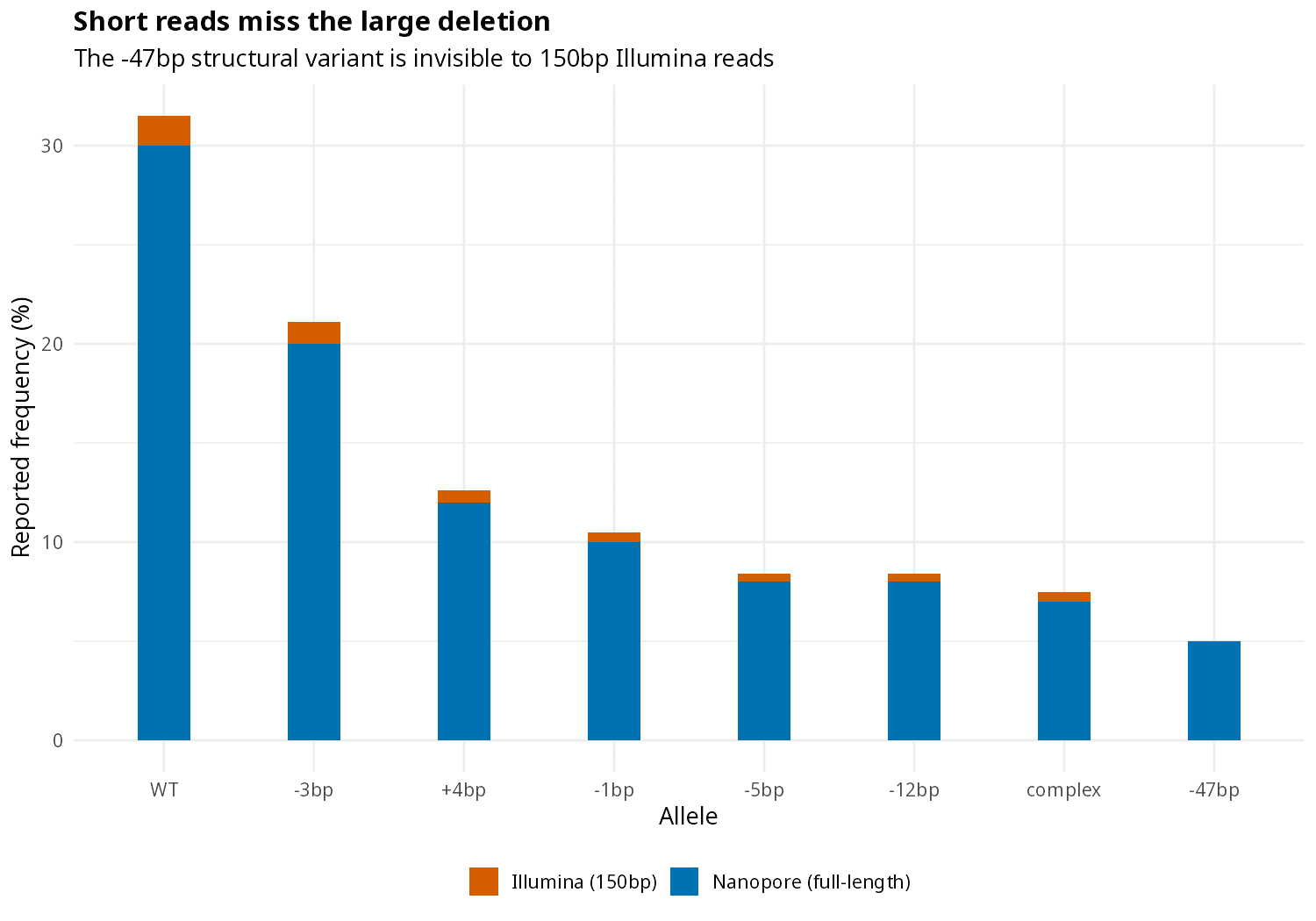
The Illumina analysis completely misses the -47 bp deletion. Its frequency is redistributed across the other alleles — making the remaining events look slightly more frequent than they actually are. In a real experiment, this could mean the difference between "we have a clean knockout" and "we have an unexpected structural variant that needs investigating."
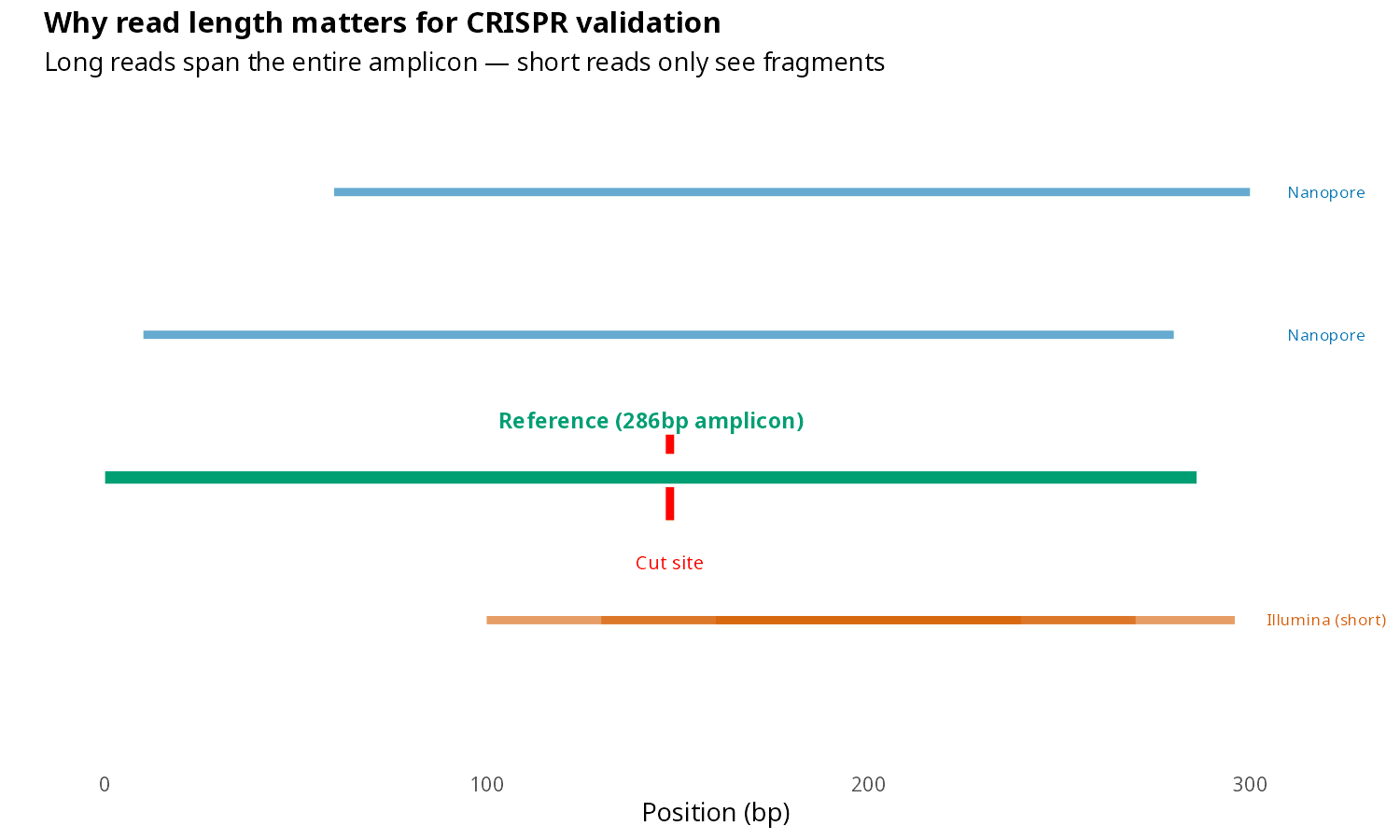
The second figure tells the story visually. Each nanopore read spans the entire 286 bp amplicon. You see both the cut site and the flanking sequence in a single read. Short Illumina reads only cover 140–200 bp of the target — they see the neighborhood around the cut site, but miss anything beyond their read length.
The honest downsides
Long-read sequencing for CRISPR is not without trade-offs. Here is what you should know before switching:
Error rate. Nanopore raw reads have a higher per-base error rate than Illumina (~1–5% depending on chemistry and basecaller). For CRISPR amplicons, this means you need to be careful distinguishing real single-base mismatches from sequencing errors. Using a minimum coverage threshold and consensus approaches helps. PacBio HiFi solves this with >Q30 per-read accuracy, but at higher cost and reduced read length range.
Throughput is overkill. A single MinION flow cell produces 10–30 Gb. Your CRISPR amplicon experiment probably needs 1–10 Mb. The flow cell capacity is vastly more than you need — which means you either multiplex many samples (which is efficient, but requires planning) or waste most of the data.
Analysis tools are less mature. CRISPResso2 is the gold standard for short-read CRISPR analysis, and it is extremely polished. The long-read equivalents (Longread-CRISPR, nanoCRISPR) are functional but rougher around the edges. You will spend more time writing custom scripts and less time running a polished pipeline.
DNA input requirements. Nanopore library prep needs more input DNA than Illumina (100 ng vs. 10 ng for typical amplicon protocols). If you are working with limited material — primary cells, sorted populations, or single-cell-derived clones — this can be a constraint.
Basecalling requires compute. The raw electrical signal data (FAST5 or POD5 files) needs to be basecalled into FASTQ. This requires a GPU or a beefy CPU. ONT provides the Dorado basecaller, which runs well on a gaming GPU (RTX 3080+) or can be done on their MinIT device.
Our take
If your CRISPR work is straightforward knockouts with small indel expectations, stay with Illumina. It is cheaper, the tools are better, and the resolution at the cut site is superior for small events.
But the moment you start seeing unusual results — higher-than-expected large deletions, unexpected bands on gels, donor integrations that do not look right in Sanger traces — long-read sequencing is the fastest way to see what is actually going on.
The Nanopore MinION is the most accessible platform for a bench biologist. The Flongle flow cell at ~$200 is cheap enough to run as a validation step before committing to a larger experiment. And the workflow is similar enough to what you already do for Illumina amplicons that the learning curve is gentle.
For our work, we use long reads specifically for donor template verification and large deletion studies. For routine indel characterization, Illumina remains the workhorse. Each platform has its job.
Resources
| Tool | What it does | Link |
|---|---|---|
| minimap2 | Long-read aligner (ONT and PacBio) | github.com/lh3/minimap2 |
| samtools | BAM manipulation, stats, and QC | samtools.github.io |
| Dorado | Oxford Nanopore basecaller (GPU-accelerated) | github.com/nanoporetech/dorado |
| Longread-CRISPR | Automated long-read CRISPR allele calling | github.com/lrautert/Longread-CRISPR |
| CRISPResso2 | Short-read CRISPR analysis (for comparison) | github.com/pinellolab/CRISPResso2 |
| NanoPlot | Nanopore run quality visualization | github.com/wdecoster/NanoPlot |
| ONT Native Barcoding Kit | Sample multiplexing for nanopore | store.nanoporetech.com |
| MinION | Benchtop nanopore sequencer | nanoporetech.com/products/minion |
| Flongle | Low-throughput nanopore flow cell | nanoporetech.com/products/flongle |
Previously in the CRISPR series: Amplicon NGS for CRISPR covers the Illumina approach in detail, and Detecting off-targets in the lab walks through genome-wide methods.
Have you run long reads on a CRISPR experiment? What did you find that your short reads missed? Drop a comment below — the comparison between the two platforms is fascinating.
Keep reading
Amplicon NGS for CRISPR: how to design your sequencing strategy
A practical guide to designing a cost-effective and accurate amplicon next-generation sequencing (NGS) strategy to quantify CRISPR editing efficiency and characterises indels.
Detecting off-targets in the lab: GUIDE-seq, CIRCLE-seq, and Digenome-seq compared
An overview and comparison of laboratory methods for finding CRISPR off-target editing. We compare GUIDE-seq, CIRCLE-seq, Digenome-seq, and DISCOVER-seq to help you choose the right validation tool.
Bash for biologists: the command line survival guide
You can run a Western blot but you are terrified of the terminal. Here is everything a bench biologist actually needs to know about the command line — navigating files, counting sequences, searching data, and writing one-liners that replace an hour of Excel work.