- Published on
- 8 min read
ToolUniverse: Democratizing AI Scientists — What It Means for Biology
- Authors

- Name
- BioTech Bench
Table of contents
The Short Version
Imagine having a research assistant who knows how to use over a thousand different scientific tools — from protein structure prediction to drug screening to literature search — and can chain them together on the fly to answer your questions. That's basically what ToolUniverse is trying to build.
Published in September 2025 by Shanghua Gao, Marinka Zitnik, and colleagues at Harvard Medical School, the paper "Democratizing AI scientists using ToolUniverse" introduces an open-source platform that connects large language models (think ChatGPT, Claude, Gemini) to hundreds of real scientific tools. The goal? Let anyone — not just programmers — build their own "AI scientist" that can actually do research tasks, not just talk about them.
Okay, But What Problem Does This Actually Solve?
If you've ever tried to run a bioinformatics analysis, you know the pain. You need one tool to search for your gene, another to predict protein structure, a third to check for drug interactions, a fourth to search the literature — and each one has its own website, its own input format, its own quirks. Half your time goes to just figuring out how to use the tools, not doing the actual science.
Now multiply that across an entire research project. Maybe you're trying to find a new drug target. You'd need to pull data from genomic databases, run some molecular property predictions, search for known compounds, check toxicity profiles, and review the literature for what's already been tried. Each step uses different software, different formats, different expertise.
This is the fragmentation problem. The tools exist — there are amazing free resources out there — but they're scattered across dozens of platforms with no way to connect them smoothly. For a biology student without a programming background, the barrier can feel impossible.
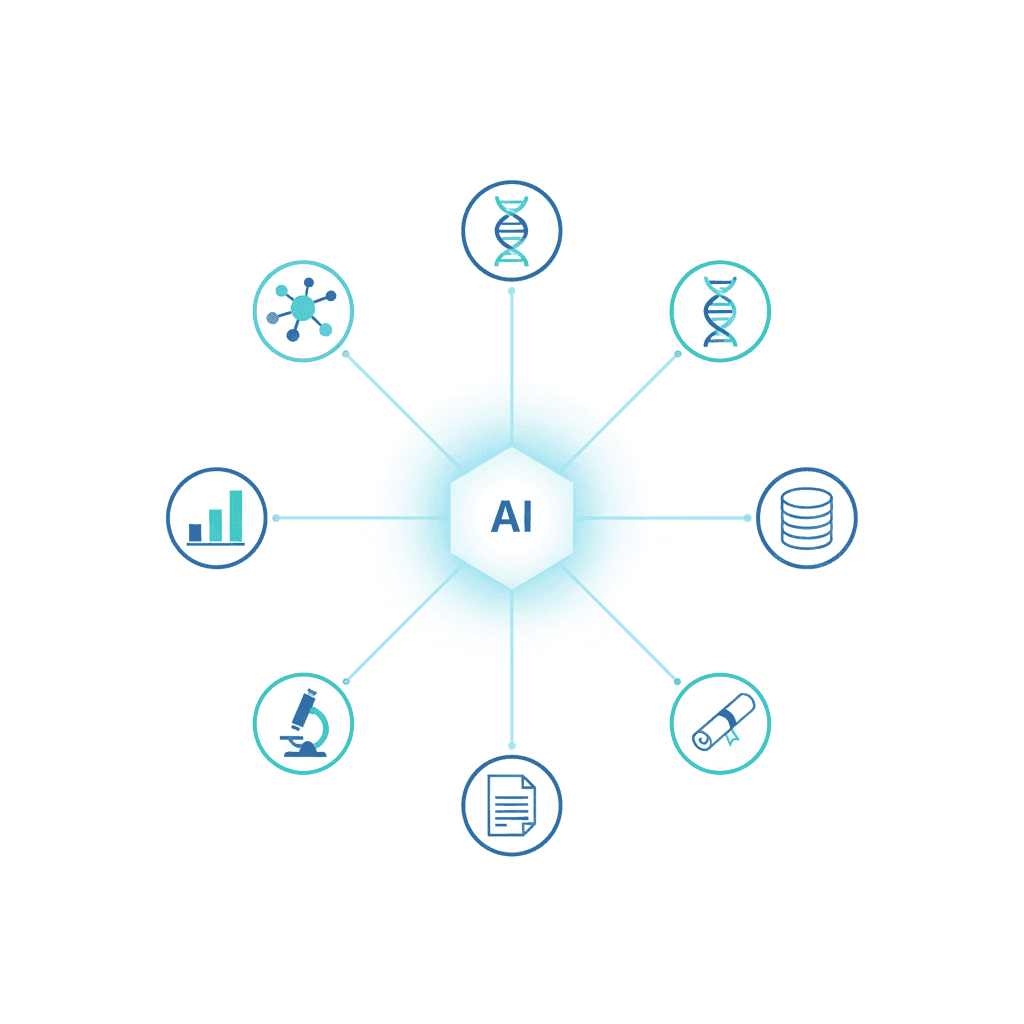
ToolUniverse tackles this head-on by putting 1,000+ scientific tools behind a single, standardized interface. Instead of learning each tool individually, you describe what you want in plain English, and the AI figures out which tools to call, in what order, and how to pass results between them.
How Does It Actually Work?
Let's break this down without the jargon.
1. A Universal Toolbox
ToolUniverse has assembled a collection of over 1,000 resources. These include:
- Machine learning models (like protein structure predictors)
- Scientific databases (for genes, drugs, diseases, pathways)
- Analysis packages (for statistics, molecular properties, visualization)
- Literature search engines (across 11+ databases including PubMed-style resources)
- APIs — basically connectors to services like Open Targets, chemical databases, and more
Each tool is wrapped in a standardized format so the AI knows exactly what inputs it needs and what outputs it produces. Think of it like giving every tool a universal plug so they all fit the same outlet.
2. You Talk, It Works
Here's where it gets interesting. You don't need to write code or know command-line syntax. You describe your question in natural language — something like "Find me compounds similar to statin drugs that might have fewer side effects" — and ToolUniverse figures out the workflow:
- Search a drug database for statin structures
- Run a molecular similarity search
- Predict properties of the similar compounds
- Filter by predicted toxicity
- Summarize the results
The AI orchestrates all of this automatically, calling the right tools in the right sequence.
3. It Works with Any AI Model
One of the clever design choices is that ToolUniverse isn't locked to a single AI model. It wraps around any large language model — OpenAI's GPT, Anthropic's Claude, Google's Gemini, or even open-source models like DeepSeek and Qwen. You pick the "brain," and ToolUniverse provides the "hands" (the tools).
4. You Can Create New Tools
This is a really neat feature. If a tool doesn't exist for your specific need, you can describe what you want in plain English, and ToolUniverse will attempt to generate a new tool from your description. It can also iteratively refine and optimize existing tools.
The Drug Discovery Case Study
The paper demonstrates ToolUniverse with a real-world-style problem: hypercholesterolemia (high cholesterol). The team used ToolUniverse to build an AI scientist that could:
- Identify an existing cholesterol drug as a starting point
- Search for structurally similar analogs (molecules that look similar but aren't identical)
- Predict which analogs might have better properties — better potency, fewer side effects, better absorption
- Rank the candidates based on multiple predicted properties
The result? The AI scientist identified a potent analog of the starting drug with favorable predicted properties — essentially doing in an automated pipeline what would normally take a medicinal chemistry team weeks of manual work with multiple separate tools.
Now, to be clear: "predicted properties" is doing a lot of heavy lifting in that sentence. These are computational predictions, not experimental results. The compound would still need to be synthesized and tested in the lab. But the point is that the discovery part — finding promising candidates — was dramatically accelerated.
What Could You Actually Do With This?
Here's where my mind starts racing. If this platform works as advertised, the applications are broad:
For students and early-career researchers:
- Run complex multi-tool analyses without needing to code
- Explore a research question quickly before committing months of bench work
- Learn bioinformatics concepts through guided, AI-assisted workflows
For wet-lab biologists:
- Screen potential drug targets computationally before going to the bench
- Quickly summarize the literature around a gene, pathway, or disease
- Generate hypotheses backed by computational evidence
For drug discovery:
- Rapid virtual screening of compound libraries
- Multi-property optimization (potency, toxicity, solubility — all at once)
- Connecting disparate databases that are normally siloed
For teaching:
- Demonstrate complex bioinformatics pipelines in a classroom setting
- Let students explore real scientific questions without needing Unix skills
- Lower the barrier between "biology" and "computational biology"
The Honest Downsides
No tool is perfect, and it's worth being clear-eyed about the limitations.
The "Black Box" Risk
When an AI chains together 10 tools automatically, do you really understand what happened? One of the biggest dangers is that researchers might trust the output without understanding the methods. In biology, methods matter — a lot. If you don't know how a protein structure was predicted or which scoring function ranked your drug candidates, you can't properly evaluate the results. And you definitely can't troubleshoot when something goes wrong.
Garbage In, Garbage Out
AI doesn't magically fix bad data. If the underlying databases have errors, if a molecular prediction model was trained on biased data, or if a tool has known limitations for your specific organism or molecule type — the AI won't necessarily catch that. It'll just confidently chain everything together and give you a polished-looking answer that might be wrong.
Reproducibility Concerns
Science needs to be reproducible. When your "methods" section says "we asked an AI to find drug candidates," that's not enough. Which model version was used? Which tools were called, with what parameters? Did the AI make different choices on a second run? These are real concerns that the community still needs to work out.
Computational Resources and Access
While ToolUniverse itself is open-source, you still need access to an LLM to power it. The best models (GPT, Claude) cost money to run through their APIs. Some of the integrated tools may require authentication or have usage limits. "Democratizing" is the goal, but there are still practical barriers.
It's Not a Replacement for Expertise
This is maybe the most important point. ToolUniverse can accelerate what an informed researcher does. It cannot replace the scientific judgment that comes from years of training. Knowing which question to ask, how to interpret unexpected results, and when to be skeptical — that's still on you.
My Take
ToolUniverse represents something genuinely exciting: the beginning of a world where the gap between "I have a biological question" and "I can computationally explore it" gets much smaller. The Zitnik Lab at Harvard has built something that could meaningfully change how biology students interact with computational tools.
But — and this is a big but — it needs to be treated as what it is: a powerful assistant, not an oracle. The biology still has to make sense. The computational predictions still need experimental validation. And the researcher still needs to understand enough about the underlying methods to know when the AI is leading them astray.
If you're a biology student reading this, my advice: learn to use tools like ToolUniverse, but also take the time to understand what's happening under the hood. The combination of biological intuition and computational power is going to be the superpower of the next generation of scientists.
And the fact that this platform is open-source and works with multiple AI models? That's a genuinely good sign for accessibility. Proprietary lock-in is the last thing science needs.
What do you think — would you trust an AI scientist to help design your next experiment? Drop a comment below.
References
Gao, S., Zhu, R., Sui, P., Kong, Z., Aldogom, S., Huang, Y., Noori, A., Shamji, R., Parvataneni, K., Tsiligkaridis, T., & Zitnik, M. (2025). Democratizing AI scientists using ToolUniverse. arXiv preprint arXiv:2509.23426. https://arxiv.org/abs/2509.23426
Zitnik Lab, Harvard Medical School. (2025). Democratizing "AI Scientists" with ToolUniverse. https://zitniklab.hms.harvard.edu/2025/09/27/ToolUniverse/
MIMS-Harvard. (2025). ToolUniverse GitHub Repository. https://github.com/mims-harvard/ToolUniverse
ToolUniverse Platform. (2025). AI Scientist Tools. https://aiscientist.tools
Zitnik, M. et al. Artificial Intelligence for Medicine and Science. Zitnik Lab, Harvard Medical School. https://zitniklab.hms.harvard.edu/
Keep reading
AlphaFold3: how it works, and how to use it to predict your protein structure
AlphaFold3 can predict your protein's 3D structure from a sequence in minutes — for free. Here's how it works, how to use the server, and what those confidence scores actually mean.
Conda for biologists: managing bioinformatics environments without losing your mind
You installed samtools and it broke your entire Python setup. Or DESeq2 needs R 4.3 but your system has R 4.1. Here is how Conda solves the dependency nightmare that every biologist runs into — with real commands, real installs, and real output.
AI in Biology in 2026: From Structural Predictions to Autonomous Wet Labs
An in-depth review of the major AI breakthroughs transforming molecular biology in 2026 — from zero-shot protein generation with ESM-3 to automated wet-lab validation loops.