- Published on
- 11 min read
Base editing explained: making precise changes without cutting DNA
- Authors

- Name
- BioTech Bench
Table of contents
This is Arc 1, Part 3 of the CRISPR from Bench to Analysis series.
You want to introduce a disease-relevant point mutation into your cell line. You design the guide, synthesize the donor oligo, optimize transfection conditions, and run the HDR experiment. Efficiency: 2%. After selection. In HEK293 cells — one of the most HDR-permissive cell types available.
Now imagine you're working with primary neurons, or hepatocytes, or any post-mitotic cell. HDR requires the cell to be in S or G2 phase. Non-dividing cells are essentially HDR-null.
Base editing was built for exactly this situation. It converts one nucleotide to another directly — no double-strand break, no donor template, no HDR required. In primary and non-dividing cell types, base editing efficiencies of 20–60% are routine. In optimized systems, they can exceed 80%.
This post covers what base editing can and can't do, how the mechanism works, and — critically — when it's the right tool versus when you should still reach for Cas9+HDR or prime editing.
What you'll learn
- What the two base editor types (CBE and ABE) actually convert
- The three components that make a base editor work
- The editing window: where in the protospacer editing happens and why
- Bystander edits: the main practical limitation and how to manage it
- A decision table: base editing vs Cas9+HDR vs prime editing
What CBE and ABE actually do
Before the mechanism, here's what matters practically. There are two classes of base editor, and they each do one thing:
| Editor | Full name | Conversion | What it's used for |
|---|---|---|---|
| CBE | Cytosine base editor | C→T (and G→A on the opposite strand) | Introduce premature stop codons, recreate disease-associated C→T SNPs, disrupt splice sites |
| ABE | Adenine base editor | A→G (and T→C on the opposite strand) | Correct pathogenic A→G point mutations, modify regulatory sequences, alter amino acid identity |
That's the full menu for base editing: two transition types. C→T and A→G.
If you need a transversion (C→A, C→G, A→T, A→C), or an insertion, or a deletion — base editing cannot help you. Those edits require prime editing (covered in Post 4) or traditional Cas9+HDR.
This constraint is important to check before you design your experiment. If your target mutation is a transversion, you can stop reading here and go to Post 4.
If your target is a C→T or A→G transition — or you want to introduce a stop codon, which is always C→T (TGG→TAG, TGG→TGA, CAG→TAG) — base editing is worth serious consideration.
How base editing works
A base editor is a fusion protein with three functional components. Understanding each one explains the constraints you'll hit in practice.
Component 1: nCas9 (the nickase)
The Cas9 in a base editor is not the standard nuclease. It's a nickase — Cas9 with one of its two cutting domains inactivated. In CBE, the HNH domain is disabled (D10A mutation); in ABE, the RuvC domain is disabled. The result is a protein that binds and unwinds the target DNA — forming the R-loop — but cuts only one strand rather than both.
This is the feature that separates base editing from standard CRISPR. No double-strand break means no NHEJ, no indels from repair, and no requirement for the HDR pathway. The cell never sees the kind of DNA damage that triggers the repair machinery CRISPR normally exploits.
Component 2: The deaminase
Fused directly to nCas9 is a deaminase enzyme — the component that actually changes the base.
When nCas9 binds its target and forms the R-loop, one strand of the DNA is displaced and becomes transiently single-stranded. The deaminase can only act on single-stranded DNA. This constraint is what creates the editing window: the deaminase can only reach bases in the portion of the protospacer that's exposed as ssDNA during R-loop formation, roughly positions 4–8 counting from the PAM-distal end (position 1).
For CBE, the deaminase (typically rAPOBEC1, or newer variants like BE4max) converts cytosine → uracil within the window. Uracil is read by polymerases as thymine — so after replication, the C:G base pair becomes T:A.
For ABE, the deaminase is an engineered version of the bacterial tRNA adenosine deaminase TadA (variants like ABE7.10, ABE8e, ABE8.20m). It converts adenine → inosine. Inosine is read as guanine — so the A:T pair becomes G:C.
Component 3: UGI (CBE only)
CBE adds a third component: uracil glycosylase inhibitor (UGI). Without it, the cell's base excision repair machinery would recognize the uracil as an error, remove it, and restore the original cytosine — undoing the edit before it can be fixed.
UGI blocks this repair. It gives the cell time to replicate the nicked strand, locking in the T:A outcome. ABE doesn't need UGI because inosine isn't recognized as a repair substrate by the same pathway.
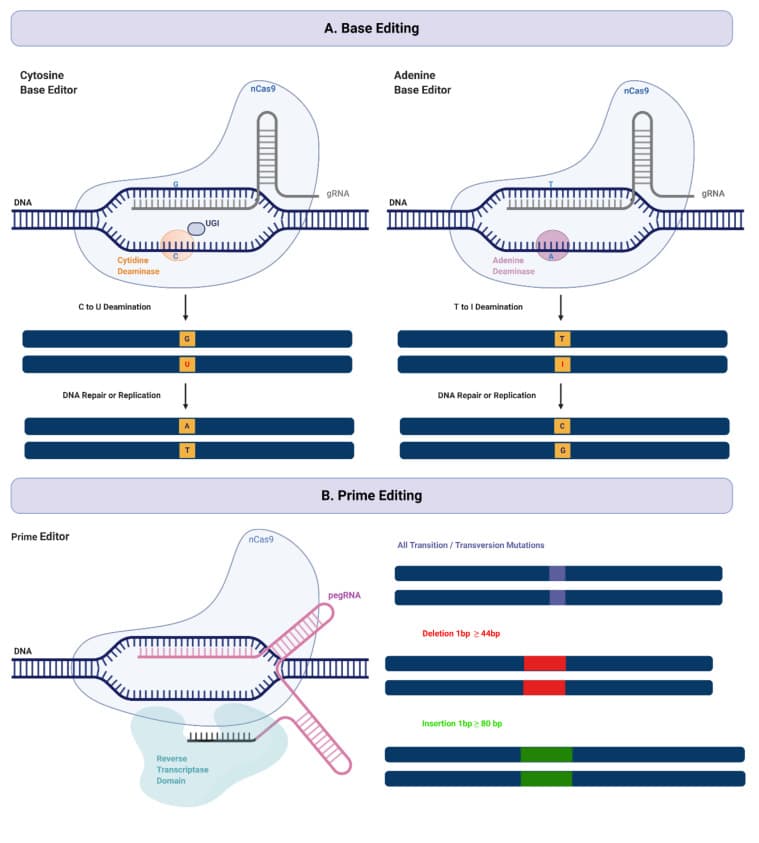
Figure 1. Schematic of cytosine base editing (CBE) and adenine base editing (ABE). CBE uses a cytosine deaminase fused to nCas9 to convert C→U (read as T), with UGI blocking uracil removal by the cell's repair machinery. ABE uses an engineered TadA deaminase to convert A→I (read as G). Both editors act within the single-stranded DNA bubble formed by the R-loop. Adapted from Kantor A et al. (2020). CRISPR-Cas9 DNA Base-Editing and Prime-Editing. _Int J Mol Sci, 21(17):6240. doi:10.3390/ijms21176240, under CC BY 4.0._
The editing window
The deaminase can only reach bases that are exposed as single-stranded DNA in the R-loop. For most SpCas9-based base editors, this corresponds to positions 4–8 of the protospacer, counting from the PAM-distal end (i.e., position 1 is the nucleotide furthest from the PAM, position 20 is the PAM-proximal end).
5'—[1][2][3][4][5][6][7][8][9]...[20]—NGG—3'
              ←  editing window  →
Before you finalize your guide RNA, count the positions of all target-compatible bases in this window. This step is non-optional.
Bystander edits
If more than one C (for CBE) or A (for ABE) falls within the editing window, all of them are candidates for editing. These unintended edits at non-target positions are called bystander edits, and they're the main practical limitation of base editing.
Example: you want to convert the C at position 5 of your protospacer. If there's also a C at position 6, CBE will likely edit both.
Managing bystander edits:
Guide selection first. Before anything else, check whether alternative guides place your target C or A alone in the editing window, with no other editable bases at positions 4–8. This is often solvable by trying a different guide that targets the opposite strand or positions the target base differently.
Use a narrower-window editor. Newer base editor variants have been engineered for tighter editing windows. YE1-BE4max (CBE) and ABE8.20m (ABE) show substantially reduced bystander activity compared to earlier versions. If your target guide has unavoidable bystander bases, switch to a high-fidelity variant.
Screen your clones. If neither of the above is possible, accept that you'll need to sequence the full editing window in your clones and select ones where only the intended base was converted. This is extra work but it's straightforward.
Most base editing design tools (BE-Designer, the Benchling base editor module) will flag bystander bases automatically — but always verify manually before ordering your guide.
Other limitations
PAM constraint. Base editors still require a PAM — the nCas9 component needs to find and bind the target. Standard SpCas9-based editors need NGG. This means the same targeting constraints that apply to Cas9 apply here: your editable base needs to land in the window of a guide that has an NGG PAM nearby. Expanded-PAM editors (SpCas9-NG, SpRY) can help when the PAM constraint is limiting, but they're generally less efficient.
Two transitions only. No transversions (C→A, C→G, A→T, A→C). No insertions. No deletions. If your experiment requires any of these, base editing is the wrong tool.
Construct size. Base editors are larger proteins than Cas9 alone — the deaminase and UGI fusions add ~500–1000 bp to the coding sequence. This complicates packaging into AAV, which has a strict ~4.7 kb cargo limit. Dual-AAV split-intein strategies exist but add delivery complexity. For ex vivo editing of dividing cells (where electroporation of mRNA or RNP is feasible), this is rarely an issue.
RNA off-targets. CBE variants with APOBEC deaminase can deaminate cytosines in transcribed RNA, not just in the genomic DNA target. This class of off-target — elevated C→U edits in the transcriptome — is reduced in newer CBE variants (A3A-BE3, BE4max with optimized UGI) but worth being aware of for therapeutic contexts.
When to use base editing
| Base editing | Cas9 + HDR | Prime editing | |
|---|---|---|---|
| Edit types | C→T, A→G only | Any (with donor) | Any transition or transversion, small indels |
| Requires donor template | No | Yes | No (pegRNA encodes the edit) |
| Works in non-dividing cells | Yes | No (HDR requires S/G2) | Yes |
| Typical efficiency | 20–60% (up to 80%+) | 1–10% | 5–50% (highly variable) |
| Indel risk | Low (nCas9 nick only) | High (DSB → NHEJ) | Low (nick only) |
| Main limitation | Bystander edits; transition edits only | Low efficiency; cell cycle dependency | Lower efficiency than base editing; pegRNA design complexity |
| Construct complexity | Moderate (larger than Cas9) | Low (standard Cas9) | High (larger than base editors) |
Use base editing when:
- Your edit is a C→T or A→G transition
- You're working in a primary, non-dividing, or hard-to-transfect cell type
- You want high efficiency without a donor template
- Indel contamination would be a problem (e.g., therapeutic applications)
Stick with Cas9+HDR when:
- You need a transversion, insertion, or deletion
- You're working in a highly dividing cell line and HDR efficiency is acceptable
- Precise sequence control is required at a level base editing can't provide
Consider prime editing when:
- Your edit is a transversion or small indel that base editing can't make
- You need flexibility on edit type without the construct complexity of HDR
- Efficiency in your cell type is sufficient (prime editing efficiency is more variable than base editing)
Common mistakes
Not checking for bystander bases before ordering. This is the most avoidable base editing mistake. Takes two minutes in BE-Designer or Benchling. Skipping it means you might run a whole experiment only to discover the edit you wanted also changed a neighboring base that disrupts the protein differently than expected.
Using a standard Cas9 expression vector. Base editors require the full deaminase fusion construct — you can't retrofit a standard SpCas9 plasmid. Make sure you're ordering or requesting the correct base editor (CBE or ABE variant), not just Cas9 with a different guide. Addgene has all major base editor constructs available.
Expecting base editing for transversion mutations. If someone in your lab says "we'll use base editing for that," check the mutation type first. Base editing only does C→T and A→G. Everything else — C→A, C→G, A→T, A→C — requires prime editing or HDR.
Using an outdated editor variant. BE3 and ABE7.10 (the original editors) work, but BE4max and ABE8e are substantially improved in efficiency and purity. If you're setting up a new base editing experiment, start with the current-generation variants.
What's next
Post 4 covers prime editing — the system that handles everything base editing can't: transversions, insertions, deletions, and multi-base changes. If base editing is a precision scalpel for transitions, prime editing is the surgical suite for everything else.
→ Next: Prime editing: how it works and when to use it over Cas9
← Previous: Cas12a (Cpf1) vs Cas9: which one should you use?
Have you used base editing in your lab? What cell type and which editor variant? Drop it in the comments — always useful to hear what's actually working at the bench.
Want the full base editor decision flowchart, guide design checklist, and troubleshooting guide? They're in the book CRISPR from Bench to Analysis.
Resources
| Resource | What it's for | Link |
|---|---|---|
| Komor et al. 2016 | Original CBE paper | Nature, 533:420–424 |
| Gaudelli et al. 2017 | Original ABE paper | Nature, 551:464–471 |
| Anzalone et al. 2020 | Base and prime editing review | Nature Biotechnology, 38:824–844 |
| Kantor et al. 2020 | Base editing mechanism review (source of Figure 1) | Int J Mol Sci, 21:6240 |
| Addgene base editing guide | Overview + plasmid catalog | addgene.org/guides/base-editing |
| BE-Designer | Guide design + bystander check for base editors | BE-Designer (CRISPR RGEN Tools) |
| Benchling | Guide design with base editor window visualization | benchling.com |
Keep reading
On-target assessment methods compared: T7E1, TIDE, and amplicon NGS
You’ve made your edit, but how much of it is actually there? This post compares the three most common ways to measure CRISPR on-target efficiency—from the "quick and dirty" T7E1 gel assay to the high-resolution precision of Amplicon NGS.
Choosing your CRISPR system and designing validated guides: an end-to-end walkthrough
You have a gene to edit. Should you use Cas9, Cas12a, or a Base Editor? This capstone post walks you through the entire workflow—from choosing the right molecular "scissors" for your target to designing and validating your final guides.
In silico off-target prediction: how the algorithms work and which tools to trust
Choosing a guide RNA that cuts your target is only half the battle. You also need one that doesn’t cut anywhere else. This post breaks down the MIT and CFD scoring systems, how off-target algorithms actually work, and which tools are best for predicting Cas9 and Cas12a off-targets.