- Published on
- 23 min read
Cas12a (Cpf1) vs Cas9: which one should you use?
- Authors

- Name
- BioTech Bench
Table of contents
- What you'll learn in this post
- The Cas12 family — a taxonomy
- How Cas12a finds its target: a T-rich PAM on the wrong side
- The guide RNA: crRNA only, no tracrRNA
- The cut: staggered ends and collateral cleavage
- Cas9 vs Cas12a: head-to-head
- When to choose Cas12a
- When Cas9 is still the right call
- Common mistakes
- Honest caveats
- What's next
- Resources
This is Arc 1, Part 2 of the CRISPR from Bench to Analysis series.
You now know how Cas9 works. It scans for NGG sequences, checks guide RNA complementarity, and cuts — producing a blunt-ended double-strand break that your cells repair through NHEJ or HDR. That's the dominant tool in the CRISPR field, and for most single-gene knockout experiments, it's exactly what you need.
But SpCas9 has real constraints. It needs a G-rich NGG PAM, which means AT-rich regions of the genome — including many promoters and regulatory elements — offer poor targeting options. Guide RNAs are relatively long. Multiplexing several targets from a single construct is awkward. And the blunt cut isn't always ideal.
Cas12a was developed partly to address these gaps. It's a different Cas protein with a different PAM, a different guide RNA structure, a different cut geometry, and an unusual extra ability: it can process its own guide RNA array, making multi-target editing from a single transcript straightforward.
This post covers the full Cas12 family first — to understand where Cas12a sits — then digs into the Cas12a mechanism, and closes with a complete head-to-head comparison to help you decide which tool fits your experiment.
What you'll learn in this post
- What the Cas12 protein family is and how it differs from Cas9 at the classification level
- How Cas12a finds its target: T-rich PAM, 5' orientation, and what that opens up
- How crRNA-only guide RNAs and Cas12a's RNase activity enable array multiplexing
- Why the staggered cut matters — and what collateral cleavage is
- A complete head-to-head comparison table covering every experimentally relevant difference
- When Cas12a has the edge over Cas9, and when Cas9 is still the better choice
The Cas12 family — a taxonomy
CRISPR-Cas systems are divided into two major classes based on how their effector machinery is assembled. Class 1 systems use a multi-protein complex to locate and cut DNA — Types I and III fall here, and while they're fascinating, their complexity has limited their use as editing tools. Class 2 systems collapse that machinery into a single, multifunctional effector protein. That architectural simplicity is exactly why Class 2 systems have dominated biotechnology: one protein is easier to engineer, deliver, and optimize than a multi-subunit complex. Both Cas9 and the Cas12 family are Class 2. More specifically, Cas9 is Class 2, Type II, while all Cas12 proteins are Class 2, Type V.
Within Type V, the Cas12 family encompasses a growing number of subtypes that all share the single-protein Class 2 architecture but diverge significantly in their biochemical properties, PAM requirements, and size. Two variants have been rigorously validated for mammalian cell editing and are the ones you will encounter in protocols, commercial reagents, and the primary literature: AsCas12a, isolated from Acidaminococcus sp. BV3L6, and LbCas12a, from Lachnospiraceae bacterium ND2006. Both are available as purified ribonucleoprotein complexes through suppliers such as Integrated DNA Technologies (IDT Alt-R system). The other subtypes below have experimental uses — particularly in diagnostics and compact delivery contexts — but are not yet standard bench tools for mammalian editing.
Class 2 — Type V (Cas12 family)
├── Cas12a (Cpf1)   — AsCas12a, LbCas12a  ← focus of this post
├── Cas12b (C2c1)   — thermostable; used in some SHERLOCK-based diagnostics
├── Cas12c          — less characterized; lower mammalian cell activity
├── Cas12d (CasY)   — discovered via metagenomics; compact architecture
├── Cas12e (CasX)   — smaller than SpCas9; shows high specificity in some studies
└── Cas12f (Cas14)  — miniature (~400–700 aa); fits within AAV packaging limits
At the domain level, Cas12a is built differently from Cas9 in a way that has real functional consequences. Cas9 uses two distinct nuclease domains — HNH cuts the DNA strand complementary to the guide, while RuvC cuts the non-complementary strand — one domain per strand. Cas12a has no HNH domain at all. Instead, a single RuvC-like domain is responsible for cleaving both strands of the target DNA. This isn't merely a structural footnote: it's part of the reason Cas12a produces staggered cuts rather than blunt ends, a distinction that carries practical implications for how your cells repair the break. (That geometry is covered in detail in the cut section below.) The original identification and characterization of Cas12a — then called Cpf1 — was published by Zetsche et al. in 2015 in Cell.
For the rest of this post, "Cas12a" refers to AsCas12a and LbCas12a unless otherwise noted.
How Cas12a finds its target: a T-rich PAM on the wrong side
A quick recap from Post 1: before Cas9 ever checks whether the guide RNA matches a candidate sequence, it first looks for a PAM — a Protospacer Adjacent Motif. The PAM is a short genomic sequence flanking the target, and the protein needs it to be present before it will even bother unwinding the DNA for guide RNA interrogation. The protospacer is the genomic sequence the guide RNA is designed to match. No PAM, no binding — regardless of how perfect the guide RNA complementarity is. Cas12a uses the same principle, but with a different sequence and, critically, a different position.
Cas12a requires a TTTN PAM — three thymines followed by any nucleotide. AsCas12a and LbCas12a both use TTTN as their canonical requirement, though LbCas12a shows a slightly different efficiency profile at degenerate positions within that motif. More important than the sequence itself is where the PAM sits. SpCas9's NGG is 3' of the protospacer — downstream on the non-template strand. Cas12a's TTTN sits 5' of the protospacer — upstream. These two orientations are the mirror image of each other:
SpCas9:  5'—[protospacer]—[NGG]—3'
Cas12a:  5'—[TTTN]—[protospacer]—3'
This inversion has a direct practical consequence. SpCas9's NGG requirement favors GC-rich sequence contexts, which is fine for much of the human coding genome but leaves AT-rich regions underserved. Promoters, enhancers, 5' UTRs, intergenic regulatory elements, and the genomes of certain organisms are AT-rich by nature. The canonical example is Plasmodium falciparum, the malaria parasite, whose genome is approximately 80% AT — making NGG PAMs genuinely scarce across large stretches. Plant non-coding regions share a similar challenge. Cas12a's TTTN requirement flips the accessibility equation: AT-rich sequences that are poorly targeted by Cas9 are frequently well-served by Cas12a, while GC-rich sequences that offer abundant NGG sites become the more constrained context for Cas12a design.
When you're working with a Cas12a gRNA design tool — CHOPCHOP, CRISPOR, and the IDT design tool all support Cas12a — the PAM appears on the 5' side of the target sequence in the output. If you're accustomed to reading Cas9 guide output, where the PAM sits to the right of the protospacer, Cas12a output can look wrong at first glance. The tools handle orientation automatically, but understanding the 5' PAM position prevents you from misinterpreting which strand is being targeted or why a given site was scored as it was. Finally, it's worth knowing that newer engineered variants — particularly enCas12a (enhanced Cas12a), developed by Kleinstiver and colleagues — have expanded PAM compatibility beyond the strict TTTN requirement, improving targeting flexibility in GC-rich contexts where wild-type Cas12a would otherwise struggle.
The guide RNA: crRNA only, no tracrRNA
To appreciate why Cas12a's guide RNA is an improvement, you need to remember what SpCas9 actually requires. SpCas9 is guided by a sgRNA (single guide RNA) — but "single" is a slight misnomer. The sgRNA is an engineered fusion of two distinct RNA molecules: the crRNA (CRISPR RNA), which contains the 20 nucleotide spacer sequence that base-pairs with the genomic target, and the tracrRNA (trans-activating crRNA), a constant scaffold sequence that folds into a stem-loop structure the Cas9 protein physically grips. In the native bacterial system these are two separate molecules; in the optimized laboratory sgRNA they are covalently linked by a short loop into a single ~100 nt transcript. This works well, but the tracrRNA scaffold component adds length, synthesis cost, and design complexity — especially when you want to deploy multiple guides at once. For multiplexing with SpCas9, the conventional approach requires a separate U6 promoter driving expression of each individual sgRNA, or a more elaborate dedicated multiplex vector architecture. Three targets means three expression cassettes.
Cas12a does away with the tracrRNA entirely. It only requires a crRNA — no fusion, no scaffold, no tracrRNA component whatsoever. The Cas12a crRNA is about 42 nucleotides in total: a ~19 nt direct repeat (DR) sequence at the 5' end, which folds into a short pseudoknot structure that the Cas12a protein recognizes, followed by a ~23 nt spacer sequence at the 3' end that specifies the genomic target. This is simpler, shorter, and meaningfully cheaper to synthesize as a chemically modified RNA oligo compared to the longer Cas9 sgRNA. There is also an orientation detail that matters for guide design: unlike SpCas9, where the spacer sits at the 5' end of the sgRNA ahead of the tracrRNA scaffold, in Cas12a the spacer is located 3' of the direct repeat. This 5'-DR–spacer-3' arrangement is the opposite of Cas9's 5'-spacer–scaffold-3' orientation, and getting this backwards when constructing an array is a common source of inactive guides.
The most consequential property of Cas12a's guide RNA system is an enzymatic one: Cas12a possesses an intrinsic RNase activity that it uses to process its own pre-crRNA. In the native bacterial context, Cas12a is transcribed as a long precursor RNA containing multiple crRNA units. The Cas12a protein binds this transcript and cleaves it at the boundaries between units, generating individual, mature, functional crRNAs. SpCas9 has no equivalent activity — it relies on a host RNase III together with the tracrRNA to process its pre-crRNAs, and this processing is not something the Cas9 protein itself performs.
This RNase activity is what enables crRNA array multiplexing — arguably the most practically useful feature distinguishing Cas12a from Cas9 for complex editing experiments. You encode multiple spacers in a single RNA transcript, formatted as a tandem array: [DR]—[spacer1]—[DR]—[spacer2]—[DR]—[spacer3]. Because each spacer is flanked by direct repeat sequences that Cas12a recognizes as cleavage sites, the protein processes this single long transcript into three individual, functional crRNAs, each of which then directs a separate cut at its respective genomic target. The practical consequence is substantial: you can edit three or four genomic targets simultaneously using a single plasmid construct with a single U6 promoter driving the entire array. Achieving the same multiplexing depth with SpCas9 typically requires three separate expression cassettes — three U6 promoters, three individual sgRNA sequences — or a specialized RNA Pol III-driven multiplex strategy that adds cloning complexity and increases the size of the delivery construct. For experiments targeting multiple genes, multiple alleles, or multiple regulatory elements in the same cell, the Cas12a array approach is significantly more practical.
It is also worth noting briefly here that this same intrinsic RNase activity — together with a separate trans-cleavage activity — is the mechanistic foundation of the DETECTR nucleic acid diagnostics platform (DNA Endonuclease-Targeted CRISPR Trans Reporter). DETECTR harnesses Cas12a to detect specific nucleic acid sequences with high sensitivity, an application that has nothing to do with genome editing but that has made Cas12a relevant far beyond the bench biology context. The trans-cleavage mechanism behind DETECTR is covered in the next section.
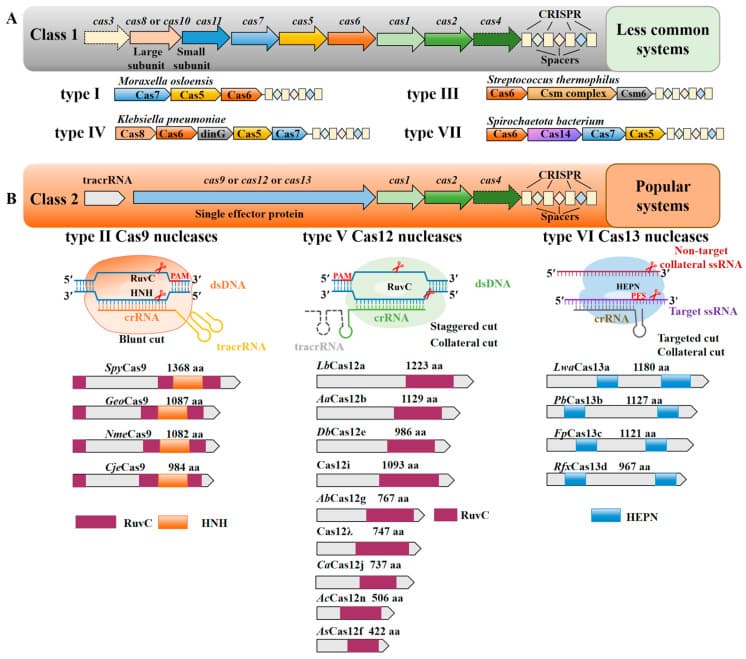
Figure 1. Class 2 CRISPR effector systems compared. (A) Type II Cas9 nucleases use a single effector protein guided by a sgRNA (crRNA fused to tracrRNA), have RuvC and HNH nuclease domains, and produce blunt-ended double-strand breaks. (B) Type V Cas12 nucleases (including Cas12a) use crRNA alone — no tracrRNA required — have a single RuvC-like domain, and produce staggered cuts with collateral ssDNA cleavage activity. Protein sizes for representative orthologs are shown. Adapted from Xuan Q et al. (2024). Research Progress and Application of Miniature CRISPR-Cas12 System in Gene Editing. _Int J Mol Sci, 25:12686. doi:10.3390/ijms252312686, under CC BY 4.0._
The cut: staggered ends and collateral cleavage
Where Cas12a cuts its target DNA is as important as whether it cuts. SpCas9 cleaves both strands at a position 3 bp upstream of the PAM — a site almost directly adjacent to the NGG motif, right at the boundary between nucleotides 3 and 4 of the protospacer counting from the PAM-proximal end. Cas12a cuts in a fundamentally different location. Because its TTTN PAM sits 5' of the protospacer, the protospacer itself extends downstream from the PAM, and Cas12a cleaves near the distal end of that protospacer — approximately 18 to 23 nucleotides away from the PAM. The cleavage site is therefore at the PAM-distal, 3' end of the target sequence rather than right next to the recognition motif. This positional difference has a quiet but significant consequence: after NHEJ repair introduces an insertion or deletion at the cut site, the resulting mutated sequence no longer closely matches the original target at the region Cas12a interrogated. The cut being far from the PAM means the repaired locus is much less likely to be re-recognized and re-cut by Cas12a in a second round, which in some contexts produces more uniform final editing outcomes compared to Cas9, where re-cutting of repaired alleles can complicate the indel distribution.
The geometry of the cut itself is equally distinctive. SpCas9 creates blunt-ended double-strand breaks: both the guide-complementary strand and the non-complementary strand are cleaved at the same position, yielding two flush ends with no single-stranded overhang on either side. Cas12a produces staggered cuts instead — the two strands are nicked at positions offset from each other by four to five nucleotides. The result is 5' overhangs of 4–5 nt on the cleaved DNA fragment. This difference in cut geometry traces directly to the domain architecture described earlier: Cas9 uses two separate nuclease domains (HNH and RuvC), one per strand, and coordinates their activity to cut at the same position; Cas12a's single RuvC-like domain cleaves both strands, but does so in a sequential, staggered manner. The 5' overhangs generated by Cas12a are analogous to what a restriction enzyme producing sticky ends would yield, which is why Cas12a has sometimes been described as a programmable restriction enzyme for genomic DNA.
These 5' overhangs have practical implications that are relevant when you are planning an HDR-based knock-in experiment. Blunt-ended Cas9 cuts require that your donor template be designed for ligation or annealing at flush ends; the sticky ends produced by Cas12a may improve annealing efficiency when using single-stranded oligonucleotide DNA (ssDNA) donor templates, because the overhangs provide a few nucleotides of sequence context for the donor to anneal against before the repair machinery extends the template. In practice, the evidence is mixed — some groups report improved HDR rates with Cas12a relative to Cas9 for ssDNA donors, others see comparable efficiency — and the outcome is cell-type dependent. This is an active area of optimization, not a settled principle. The broader point is that when your experiment depends on HDR with an ssDNA template, Cas12a's staggered cut geometry is worth testing empirically rather than assuming the blunt Cas9 cut is always the better default.
Beyond its on-target cutting activity, Cas12a possesses a second, entirely distinct nuclease behavior that activates only after target binding. Once Cas12a has located and cleaved its specific genomic target in cis — meaning it has verified guide RNA complementarity, found the PAM, and made the double-strand break — the protein undergoes a conformational change that opens up a separate, sequence-nonspecific ssDNA cleavage activity. In this activated state, Cas12a will indiscriminately cut any single-stranded DNA molecule it encounters in the surrounding environment, regardless of sequence. This is called collateral cleavage or trans-cleavage, to contrast it with the sequence-specific cis-cleavage of the intended target. This trans-cleavage activity is not present in Cas9, which ceases to be catalytically active once it has made its targeted cut. Collateral cleavage is a fundamentally different biological behavior, not merely a side reaction, and understanding it is important both for exploiting it as a detection tool and for avoiding it as an off-target artifact in editing experiments.
The trans-cleavage activity is the biochemical foundation of the DETECTR platform (DNA Endonuclease-Targeted CRISPR Trans Reporter), developed by the Doudna lab (Chen et al., 2018, Science, doi:10.1126/science.aar6245). In a DETECTR assay, if the target sequence — for example, a viral genomic region present in a patient sample — is present, Cas12a binds it and triggers the cis-cleavage event, which in turn activates the collateral trans-cleavage activity. The reaction mixture contains a short ssDNA reporter molecule labeled with a fluorophore-quencher pair that keeps it dark when intact. Activated Cas12a chews through this reporter, separating the fluorophore from the quencher and producing a measurable fluorescent signal. No target, no cis-cleavage, no activation, no signal. DETECTR has been applied to SARS-CoV-2 detection and other pathogen diagnostics, demonstrating attomolar sensitivity. The practical note for bench biologists working with Cas12a for gene editing is the inverse: if your downstream assay involves ssDNA reporters, fluorescent oligo probes, or any ssDNA component present in the same tube as a Cas12a-guide RNA complex, be aware that activated Cas12a may nonspecifically degrade them. This is worth explicitly checking when troubleshooting unexpected probe signal loss or designing any format — including T7E1-adjacent or mismatch cleavage assays — where ssDNA is a functional component of the readout.
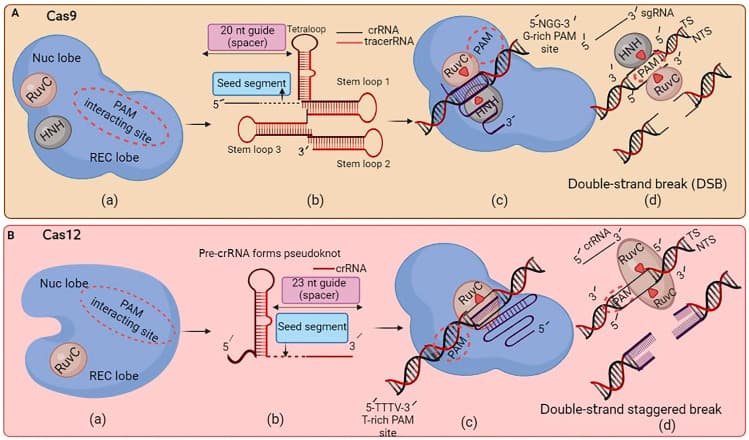
Figure 2. Cas9 versus Cas12a: key mechanistic differences. (A) Cas9 uses two nuclease domains (RuvC and HNH), requires a sgRNA composed of crRNA fused to tracrRNA, recognises an NGG PAM at the 3′ end of the protospacer, and produces blunt-ended double-strand breaks. (B) Cas12a uses a single RuvC-like domain, requires only a crRNA with no tracrRNA, recognises a T-rich TTTV PAM at the 5′ end of the protospacer, and produces 5′ staggered breaks (sticky ends). Adapted from Movahedi A et al. (2023). CRISPR Variants for Gene Editing in Plants: Biosafety Risks and Future Directions. _Int J Mol Sci, 24:16241. doi:10.3390/ijms242216241, under CC BY 4.0._
Cas9 vs Cas12a: head-to-head
The mechanistic differences between SpCas9 and Cas12a translate directly into experimental considerations at every stage of experimental design — from target selection and guide RNA synthesis to delivery format and downstream analysis. The table below summarizes every major dimension of comparison. Not every difference will matter for your specific experiment; the goal is to give you the vocabulary to evaluate your own situation.
| Feature | SpCas9 | AsCas12a / LbCas12a |
|---|---|---|
| CRISPR class / type | Class 2, Type II | Class 2, Type V |
| PAM sequence | NGG (3' of protospacer) | TTTN (5' of protospacer) |
| Genomic preference | GC-rich regions | AT-rich regions |
| Guide RNA | sgRNA (~100 nt) | crRNA (~42 nt) |
| tracrRNA required | Yes | No |
| Pre-crRNA processing | No | Yes (intrinsic RNase) |
| Multiplexing | Requires separate promoters per guide | Array processing from one transcript |
| Cut type | Blunt-ended DSB | 5' staggered overhangs (4–5 nt) |
| Cut position | 3 bp upstream of PAM | 18–23 bp downstream of PAM |
| Collateral ssDNA cleavage | No | Yes (trans-cleavage on activation) |
| Protein size | ~1,368 aa (SpCas9) | ~1,307 aa (AsCas12a) |
| Tool / reagent support | Extensive | Well-validated, growing |
When to choose Cas12a
Cas12a has a real advantage in four specific experimental situations — and in each one, the benefit is mechanistic, not marginal.
Your target is in an AT-rich region with sparse NGG PAM options. Count every NGG site within 200 bp of your target of interest. If there are fewer than 3–4 viable Cas9 guides — meaning guides with a good on-target score and no seed region repeats — Cas12a's TTTN PAM is worth checking. AT-rich regions, including many promoters, regulatory elements, and the genomes of organisms such as Plasmodium falciparum, are routinely underserved by SpCas9 but offer dense TTTN coverage. CRISPOR and CHOPCHOP both support Cas12a guide design and will show you your options quickly.
You need to edit three or more targets from a single construct. For CRISPR screens, pathway disruption experiments, or any multiplex knockout requiring three or more simultaneous edits, Cas12a's crRNA array processing makes multiplexing significantly more practical. You encode multiple spacers in a single tandem array transcript — one promoter, one RNA, multiple functional crRNAs after Cas12a processes the array. Achieving the same depth of multiplexing with SpCas9 typically requires a separate expression cassette for each guide, multiplying cloning complexity and construct size.
You are developing a nucleic acid diagnostic using DETECTR or a similar Cas12a trans-cleavage format. The collateral ssDNA cleavage activity that Cas12a activates after target binding is the entire point of these platforms — it is what converts a target-recognition event into a quantifiable fluorescent signal. Cas9 does not possess this trans-cleavage activity and cannot be substituted in these assay formats.
Smaller, simpler guide RNA is an advantage for your delivery format. In lipid nanoparticle (LNP) or ribonucleoprotein (RNP) delivery formats where RNA payload size is a practical constraint, the ~42 nt Cas12a crRNA offers a real advantage over the ~100 nt Cas9 sgRNA. Lower synthesis cost and reduced payload mass can improve loading efficiency and simplify RNP assembly, particularly when working with hard-to-transfect primary cells or in vivo delivery contexts.
When Cas9 is still the right call
For most single-gene knockout experiments in standard mammalian cell lines, SpCas9 remains the default for good reason — and switching to Cas12a without a concrete motivation adds complexity without benefit.
Good NGG PAM sites are available near your target. If CRISPOR or CHOPCHOP returns four or more well-scoring Cas9 guides near your target, the NGG constraint is not a real limitation. Sparse PAM coverage is the primary mechanistic motivation for switching to Cas12a — if that problem doesn't exist in your specific locus, use the better-characterized tool.
You are doing a single-gene knockout in a standard cell line. For HEK293, HeLa, Jurkat, iPSC, or any other commonly used mammalian cell line with a well-established Cas9 transfection protocol, SpCas9 is the path of least resistance. The delivery conditions are optimized, the commercial reagents are widely available, and the troubleshooting literature is extensive. A failed Cas9 experiment has an enormous body of community knowledge to draw on; a failed Cas12a experiment in a non-standard cell type has considerably less.
You need the broadest tool and reagent support. Most gRNA design tools list Cas9 as their default. Most commercial RNP products — including IDT Alt-R Cas9 and Synthego SpCas9 — are SpCas9 products with validated protocols for a wide range of cell types. Most published CRISPR protocols are SpCas9-based. Switching to Cas12a means confirming that compatible protocols exist for your specific cell type and delivery format, which adds a verification step before the experiment even begins.
You are new to CRISPR. Learn the tool with the most documentation, the largest community, and the most troubleshooting guidance available. Understanding why an experiment works or fails with Cas9 — guide efficiency, delivery optimization, editing outcome analysis — builds the conceptual foundation you need to evaluate whether Cas12a would offer a genuine advantage for your next experiment. Starting with the simpler, better-supported system and switching when you have a specific reason is a more reliable path than adopting Cas12a by default.
Common mistakes
Putting the PAM on the wrong side. Cas12a's TTTN PAM is 5' of the protospacer. Designing as if it were 3' — the Cas9 habit — produces guides that won't work. Design tools like CHOPCHOP and CRISPOR place the PAM correctly when you select Cas12a, but if you're manually checking or adapting a sequence, the orientation is easy to flip. Always verify with a Cas12a-aware tool before synthesis.
Conflating AsCas12a and LbCas12a. Both recognize TTTN, but their efficiency profiles at specific target sequences differ. LbCas12a can show higher activity at some targets; AsCas12a has more published validation across cell types. The practical advice: use whichever variant your commercial provider (IDT, Addgene) has validated protocols for in your cell type, and specify which variant you used in your methods section.
Assuming Cas12a is always more specific than Cas9. Some studies show reduced off-target rates for Cas12a; others show comparable rates. Specificity depends on guide sequence, protein concentration, cell type, and chromatin context — not on which Cas protein you use. Run off-target analysis regardless. The specificity advantage is not categorical.
Forgetting collateral cleavage when ssDNA is involved. If your experimental workflow includes ssDNA probes, reporters, or oligonucleotides in the same reaction as an active Cas12a–guide RNA complex — even transiently — the trans-cleavage activity can degrade them nonspecifically. This is a known confound in certain diagnostic and detection assay formats.
Honest caveats
The specificity comparisons cited throughout this post are drawn from published head-to-head studies, but the results vary significantly by guide sequence, target locus, cell type, and experimental conditions. Do not assume the published average translates directly to your specific guide or cell system.
Multiple engineered Cas12a variants exist beyond the wild-type AsCas12a and LbCas12a described here. enCas12a (enhanced Cas12a) has expanded PAM tolerance and improved editing efficiency at some targets. hyperCas12a shows further improvements in activity. If you are reading recent literature, check which variant was used — the version matters for interpreting efficiency numbers.
The Cas12 family is an active area of research. Cas12b, Cas12e/CasX, and Cas12f/Cas14 are all being actively developed for genome editing applications, with Cas12f in particular attracting attention for AAV delivery contexts due to its small size. The tool landscape will continue to shift.
What's next
Post 3 covers base editing — a CRISPR approach that makes precise single-nucleotide changes without cutting both strands of DNA. Base editors were developed specifically to circumvent the efficiency and safety limitations of HDR, and they have become one of the most clinically relevant precision editing tools in the field.
→ Read Post 3: Base editing explained: making precise changes without cutting DNA (coming March 5)
Want the complete decision framework, PAM site mapping examples, and a guide RNA design checklist for both Cas9 and Cas12a? They're in the book CRISPR from Bench to Analysis — including worked examples for AT-rich target selection and multiplexing construct design.
Have you used Cas12a in your experiments? Or are you trying to decide between Cas9 and Cas12a for an upcoming project? Drop a comment below.
Resources
| Resource | What it's for | Link |
|---|---|---|
| CHOPCHOP | gRNA design for Cas9 and Cas12a | chopchop.cbu.uib.no |
| CRISPOR | gRNA design + off-target prediction (Cas12a supported) | crispor.tefor.net |
| Benchling | Full CRISPR design suite, Cas12a support | benchling.com |
| Zetsche et al. 2015 | Original Cas12a / Cpf1 characterization paper | Cell, 163:759–771 |
| Chen et al. 2018 | DETECTR: Cas12a collateral cleavage for diagnostics | Science, 360:436–439 |
| Addgene CRISPR guide | Cas12a protocols and troubleshooting | addgene.org/guides/crispr |
| Movahedi et al. 2023 | CRISPR variants in plants — Fig. 1 Cas9 vs Cas12a | IJMS, 24:16241 |
| Xuan et al. 2024 | Miniature CRISPR-Cas12 systems — Fig. 1 Class 2 overview | IJMS, 25:12686 |
Keep reading
On-target assessment methods compared: T7E1, TIDE, and amplicon NGS
You’ve made your edit, but how much of it is actually there? This post compares the three most common ways to measure CRISPR on-target efficiency—from the "quick and dirty" T7E1 gel assay to the high-resolution precision of Amplicon NGS.
Choosing your CRISPR system and designing validated guides: an end-to-end walkthrough
You have a gene to edit. Should you use Cas9, Cas12a, or a Base Editor? This capstone post walks you through the entire workflow—from choosing the right molecular "scissors" for your target to designing and validating your final guides.
In silico off-target prediction: how the algorithms work and which tools to trust
Choosing a guide RNA that cuts your target is only half the battle. You also need one that doesn’t cut anywhere else. This post breaks down the MIT and CFD scoring systems, how off-target algorithms actually work, and which tools are best for predicting Cas9 and Cas12a off-targets.