- Published on
- 15 min read
Prime editing: how it works and when to use it over Cas9
- Authors

- Name
- BioTech Bench
Table of contents
This is Arc 1, Part 4 of the CRISPR from Bench to Analysis series.
You need to make a 3-bp deletion in a coding region. Or introduce a transversion — C→A — to model a patient-specific SNP. Or insert a short epitope tag for downstream detection. Base editing can't help: it only does C→T and A→G transitions. HDR could work in theory, but you're in primary T cells, efficiency is hovering around 2%, and most of your "edited" cells are actually indel-contaminated from NHEJ repair of the double-strand break.
Prime editing is the third option. Any edit type — transitions, transversions, insertions up to ~40 bp, deletions up to ~80 bp — without a DSB, without a donor oligo, and functional in non-dividing cells. It's not magic; efficiency is variable and pegRNA design is more complex than standard guide design. But when you need an edit that base editing can't make and HDR won't work, prime editing is often the only practical path.
This post covers what prime editing can do, how the mechanism works, which system variant to use, and when it's the right tool versus base editing or Cas9+HDR.
What you'll learn
- What prime editing can do that base editing and Cas9+HDR can't
- The three components: nCas9-RT fusion, pegRNA, nicking guide
- How the "search and replace" mechanism works
- PE2 vs PE3 vs PE3b vs PE7: efficiency vs purity trade-offs
- When to use prime editing vs base editing vs HDR
- Limitations: efficiency variability, pegRNA design complexity
What prime editing can do
Before the mechanism, here's the practical capability comparison. This table answers the question: which system can make which edit?
| Edit type | Base editing | Cas9+HDR | Prime editing |
|---|---|---|---|
| Transitions (C→T, A→G) | Yes | Yes | Yes |
| Transversions (C→A, G→T, etc.) | No | Yes | Yes |
| Small insertions (1–40 bp) | No | Yes | Yes |
| Small deletions (1–80 bp) | No | Yes | Yes |
| Requires DSB | No | Yes | No |
| Requires donor template | No | Yes | No |
| Works in non-dividing cells | Yes | No | Yes |
| Typical efficiency | 20–60% | 1–10% | 5–50% |
| Indel byproducts | Low | High | Low |
The key insight: prime editing is the only system that combines flexible edit types (like HDR) with DSB-free editing (like base editing). That combination is why it exists.
If your edit is a simple C→T or A→G transition, base editing will usually be more efficient and easier to design. Use it. If you're in a highly dividing cell line and HDR efficiency is acceptable for your application, that's also fine.
But if you need a transversion, a small indel, or you're working in non-dividing cells and base editing can't make your edit — prime editing is your tool.
How prime editing works
Prime editing uses three components working together. Understanding each one explains why the system can make edits that base editing can't, while still avoiding the double-strand break that makes HDR so inefficient.
Component 1: nCas9-RT fusion (the prime editor protein)
The protein at the center of prime editing is a fusion of two enzymes: Cas9 nickase and reverse transcriptase.
The Cas9 component carries the H840A mutation, which inactivates the HNH nuclease domain. This means it nicks only the PAM strand — the strand containing the NGG — and leaves the opposite strand intact. No double-strand break, no NHEJ activation, no indel generation from the cut itself.
Fused to the C-terminus of this nickase is an engineered M-MLV reverse transcriptase (from Moloney murine leukemia virus). This is the component that actually writes the edit. Unlike base editors, which chemically modify existing bases, the RT synthesizes new DNA sequence directly at the nick site, using an RNA template.
The fusion architecture means both functions — target binding and DNA synthesis — are delivered in a single protein. The nCas9 finds and nicks the target; the RT writes the new sequence at that location.
Component 2: pegRNA (prime editing guide RNA)
The pegRNA is the component that makes prime editing programmable for any edit type. It's an extended guide RNA with two additional elements at the 3' end:
PBS (primer binding site): A short sequence (~13 nt) that hybridizes to the 3' end of the nicked PAM strand. This creates the primer the RT needs to initiate DNA synthesis. The PBS sequence is complementary to the genomic sequence immediately upstream of the nick.
RTT (RT template): The sequence that encodes the desired edit. The RT reads this template and synthesizes a new DNA strand containing whatever sequence you've designed — a point mutation, a small insertion, a deletion, or a combination.
The standard guide portion (spacer + scaffold) does what it always does: directs Cas9 to the target site. But the 3' extensions — PBS and RTT — turn the pegRNA into a "search and replace" instruction. The spacer finds the target (search); the RTT specifies the replacement.
This is why prime editing can make any small edit: you're not limited by deaminase chemistry or window constraints. You're directly encoding the output sequence in the pegRNA.
Component 3: Nicking guide (PE3/PE3b systems)
The basic prime editing system (PE2) uses only the nCas9-RT fusion and pegRNA. It works, but efficiency is often low because the cell has to resolve a mismatch between the edited strand and the original strand — and the original strand often wins.
PE3 adds a second guide RNA that nicks the non-edited strand, typically ~50 bp away from the pegRNA nick site. This nick biases cellular repair toward using the edited strand as the template, increasing editing efficiency substantially (often 2–5× higher than PE2).
The trade-off: the second nick can itself be processed, occasionally generating small indels at the nicking guide site. PE3b mitigates this by designing the nicking guide to only bind after the edit is installed — meaning the second nick only occurs if prime editing succeeded. This reduces indel byproducts while retaining the efficiency boost.
The mechanism step by step
Here's what happens during prime editing:
Target binding and nicking. The nCas9-RT fusion binds the target site via the pegRNA spacer and nicks the PAM strand. The non-edited strand remains intact.
PBS hybridization. The PBS at the 3' end of the pegRNA hybridizes to the exposed 3' end of the nicked PAM strand. This creates a primer-template junction.
Reverse transcription. The RT uses the RTT as a template and synthesizes a new DNA strand extending from the nicked 3' end. This new DNA contains the programmed edit.
Flap competition. The newly synthesized strand (3' flap, containing the edit) and the original downstream sequence (5' flap, unedited) compete for incorporation into the genome. Cellular 5' flap endonucleases preferentially remove the 5' flap.
Repair and resolution. The remaining mismatch between the edited strand and the non-edited strand is resolved by cellular mismatch repair. With PE3/PE3b, the nick on the non-edited strand biases repair toward copying the edited sequence.
The result: the edit is installed without a double-strand break, without a donor template, and without requiring HDR.
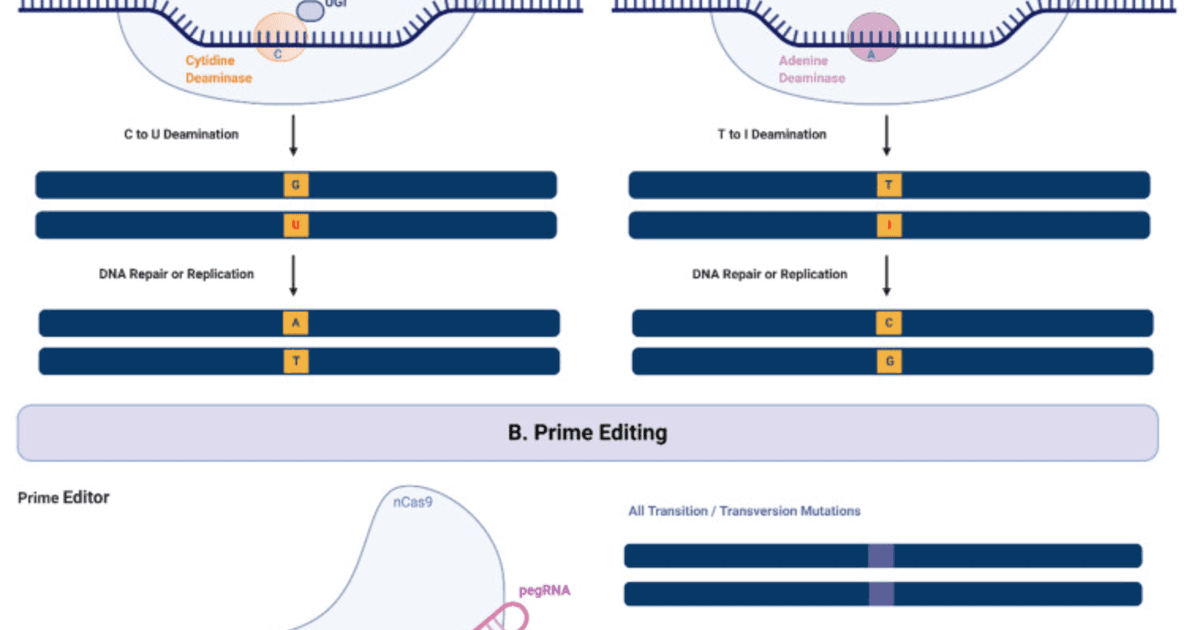
Figure 1. Prime editing mechanism. The pegRNA guides nCas9-RT to the target, where the PBS hybridizes to the nicked strand and the RT template provides the edited sequence. Adapted from Kantor A et al. (2020). CRISPR-Cas9 DNA Base-Editing and Prime-Editing. Int J Mol Sci, 21(17):6240. doi:10.3390/ijms21176240, under CC BY 4.0.
PE2 vs PE3 vs PE3b vs PE7
The mechanism section introduced PE2 and PE3 briefly. Here's the practical breakdown of all four systems, including when to use each one.
PE2
What it is: The pegRNA plus the prime editor protein. No nicking guide, no second nick.
Efficiency: Typically 5–20%, depending on target site and cell type.
Indels: Very low (<1%). Because there's no second nick, there's minimal substrate for indel-generating repair.
When to use: PE2 is your system when purity matters more than efficiency. Use it for initial pegRNA screening to identify functional guides before switching to PE3. Use it for therapeutic applications where any indel contamination is unacceptable. Use it when you need clean editing and can tolerate lower efficiency.
PE3
What it is: The pegRNA plus the prime editor protein plus a nicking guide that cuts the non-edited strand, typically ~50 bp from the pegRNA nick site.
Efficiency: Typically 20–50%, or 2–5× higher than PE2 at the same target.
Indels: Moderate (5–15%). The second nick creates a substrate for indel formation, particularly if the edit doesn't install before the non-edited strand is processed.
When to use: PE3 is your default system for most applications. Use it when efficiency is the priority and some indel contamination is acceptable. It's the workhorse for general-purpose prime editing.
PE3b
What it is: Like PE3, but the nicking guide is designed to only bind after the edit is installed. The edit itself disrupts the nicking guide's PAM or seed sequence, so the second nick only occurs if prime editing succeeded.
Efficiency: Similar to PE3.
Indels: Lower than PE3, because the second nick is contingent on successful editing. The non-edited strand only gets nicked in cells where the edit is already present.
When to use: PE3b is ideal when your edit happens to disrupt the nicking guide's target sequence. This isn't always possible — it depends on the local sequence context — but when it works, you get PE3-level efficiency with fewer indels. Check for PE3b compatibility during pegRNA design.
PE7
What it is: An optimized system with engineered RT variants (improved M-MLV mutants) and enhanced pegRNA architecture with stabilized scaffolds that resist cellular degradation.
Efficiency: Substantially higher than PE3 across cell types, including primary and hard-to-transfect cells.
Features: Reduced pegRNA degradation extends the functional half-life of the editing complex. The optimized RT improves polymerization on difficult templates. Together, these changes enable longer insertions and better performance at hard-to-edit loci.
When to use: PE7 is your escalation option. Use it when PE3 efficiency is insufficient at your target. Use it for longer insertions (>15 bp) where standard PE3 struggles. Use it in primary cells or other challenging contexts where delivery and expression are limiting factors.
Practical recommendation
Start with PE3 for most projects. It balances efficiency and simplicity, and it's well-characterized across many target sites and cell types.
If PE3 efficiency is low at your target, try PE7. The improved RT and pegRNA architecture often rescue difficult sites.
Use PE2 when indel purity is critical — therapeutic applications, precise disease modeling, or any context where indel contamination would confound your results.
Use PE3b when your edit naturally disrupts the nicking guide's PAM or seed sequence. Check this during pegRNA design; if it's available, PE3b gives you PE3 efficiency with cleaner outcomes.
When to use prime editing
Here's the full comparison between prime editing, base editing, and Cas9+HDR. Use this table to choose the right system for your edit.
| Prime editing | Base editing | Cas9 + HDR | |
|---|---|---|---|
| Edit types | All transitions, transversions, indels up to ~40–80 bp | C→T, A→G only | Any (with donor template) |
| Requires donor template | No (edit in pegRNA) | No | Yes |
| Works in non-dividing cells | Yes | Yes | No (HDR needs S/G2) |
| Typical efficiency | 5–50% (PE2–PE7) | 20–60% | 1–10% |
| Indel byproducts | Low (PE2) to moderate (PE3) | Low | High (NHEJ competes) |
| Design complexity | High (pegRNA + optional nick guide) | Moderate (editing window constraints) | Low (standard gRNA + donor) |
| Construct size | Largest (~6.3 kb) | Large (~5.5 kb) | Standard (~4.2 kb) |
| Main limitation | Efficiency variability; pegRNA optimization | Transitions only; bystander edits | Low efficiency; cell cycle; indels |
Use prime editing when:
- Your edit is a transversion, insertion, or deletion that base editing can't make
- You're working in non-dividing or primary cells where HDR won't work
- You need precision without DSB-induced indel contamination
- Base editing window constraints don't fit your target
Use base editing instead when:
- Your edit is C→T or A→G — base editing is simpler and typically more efficient
- Your target C or A falls cleanly in the editing window without bystander bases
Use Cas9+HDR when:
- You need large insertions (>40 bp) or complex replacements
- You're in a highly dividing cell line with acceptable HDR efficiency
- Donor template design is straightforward for your edit
Limitations
Prime editing is powerful, but it has real constraints. Knowing these upfront prevents failed experiments and mismatched expectations.
Efficiency is highly variable. The same PE3 system that gives 50% editing at one site may give <5% at another in the same cell type. Target sequence context, local chromatin state, pegRNA folding, and PBS/RTT parameters all affect efficiency. Don't assume a single pegRNA design will work — plan for optimization.
pegRNA design is complex. Unlike standard gRNAs, pegRNAs have multiple tunable parameters: PBS length (typically 10–16 nt), RTT length (typically 10–20 nt), and spacer selection relative to the edit position. Each parameter affects efficiency, and optimal values vary by target. Tools like PrimeDesign help, but empirical testing of 2–3 pegRNA variants is often necessary.
Construct size limits delivery options. Prime editors are the largest CRISPR constructs — the PE2 protein alone is ~6.3 kb. This exceeds the ~4.7 kb packaging limit of standard AAV vectors. Solutions exist: dual-AAV split-intein approaches, lentiviral delivery, or mRNA/RNP transfection. But each adds complexity, and AAV-based in vivo delivery remains challenging. For therapeutic development, delivery is often the bottleneck, not editing efficiency.
PolyT stretches cause RT termination. Runs of 4+ consecutive Ts in the RTT can trigger premature termination of reverse transcription, truncating the edit before completion. This is a direct consequence of using a retroviral RT. Where possible, design around polyT stretches by repositioning the edit or using the complementary strand. If avoidance isn't possible, PE7's stabilized pegRNA scaffold partially mitigates this issue by improving RT processivity.
Longer edits are less efficient. Insertions above ~15 bp and deletions above ~30 bp show progressively lower efficiency. PE7 extends these limits somewhat, but prime editing is fundamentally optimized for small precise edits, not large sequence changes.
Common mistakes
These are the errors that waste time and reagents. Avoiding them gets you to working edits faster.
1. Not optimizing PBS and RTT length. Default parameters (~13 nt PBS, ~10–15 nt RTT) work for many targets, but they're not universal. At difficult sites, testing 2–3 PBS lengths (e.g., 10, 13, 16 nt) can double editing efficiency. The same applies to RTT length — longer isn't always better, and shorter RTTs sometimes outperform longer ones. Budget time for this optimization; it's not optional at challenging targets.
2. Using PE2 when PE3 or PE7 is needed. PE2 is clean and simple, but its efficiency is often too low for practical use — 5–10% editing in cells where PE3 would give 30–40%. If you're struggling with efficiency, don't assume your pegRNA is broken; try PE3 first. PE2 is for purity-critical applications, not for initial screening.
3. Ignoring pegRNA design tools. PrimeDesign and pegFinder exist because manual pegRNA design is error-prone. These tools predict optimal PBS/RTT parameters, check for secondary structure issues, identify potential off-target sites, and flag problematic sequences (like polyT runs). Manual design misses these considerations and often produces non-functional or suboptimal guides. Use the tools.
4. Expecting base editing efficiency. Prime editing is more flexible than base editing, but typically less efficient for comparable cell types and targets. A 20–30% prime editing efficiency is often a good outcome — don't treat it as a failure because base editing routinely hits 40–50%. Set realistic expectations based on published benchmarks for your system and cell type.
What's next
The next post covers gRNA design principles for Cas9 and Cas12a — what makes a guide effective, how on-target scoring algorithms work, and strategies for minimizing off-target activity. Whether you're designing guides for knockouts, base editing, or prime editing, the fundamentals of good guide selection apply across systems.
→ Next: What makes a good gRNA: Cas9 and Cas12a guide design principles
← Previous: Base editing explained: making precise changes without cutting DNA
Join the conversation
Have you tried prime editing in your lab? What efficiency did you get, and which system variant (PE2/PE3/PE7) worked best for your target? Drop a comment below — especially if you have tips on pegRNA optimization or delivery in primary cells.
Resources
| Resource | What it's for | Link |
|---|---|---|
| Anzalone et al. 2019 | Original prime editing paper describing PE2/PE3 | Nature 576:149–157 |
| Chen et al. 2021 | PE4/PE5 improvements with engineered MLH1dn | Cell 184(22):5635–5652 |
| PrimeDesign | pegRNA design tool from Broad Institute | primedesign.pinellolab.partners.org |
| pegFinder | Alternative pegRNA designer with batch mode | pegfinder.sidichenlab.org |
| Addgene Prime Editing Guide | Plasmid catalog and protocol overview | addgene.org/guides/prime-editing |
Keep reading
On-target assessment methods compared: T7E1, TIDE, and amplicon NGS
You’ve made your edit, but how much of it is actually there? This post compares the three most common ways to measure CRISPR on-target efficiency—from the "quick and dirty" T7E1 gel assay to the high-resolution precision of Amplicon NGS.
Choosing your CRISPR system and designing validated guides: an end-to-end walkthrough
You have a gene to edit. Should you use Cas9, Cas12a, or a Base Editor? This capstone post walks you through the entire workflow—from choosing the right molecular "scissors" for your target to designing and validating your final guides.
In silico off-target prediction: how the algorithms work and which tools to trust
Choosing a guide RNA that cuts your target is only half the battle. You also need one that doesn’t cut anywhere else. This post breaks down the MIT and CFD scoring systems, how off-target algorithms actually work, and which tools are best for predicting Cas9 and Cas12a off-targets.