- Published on
- 15 min read
What makes a good gRNA: Cas9 and Cas12a guide design principles
- Authors

- Name
- BioTech Bench
Table of contents
- What you'll learn
- What makes a Cas9 guide work (or not)
- On-target scoring algorithms — what they measure and why
- Off-target risk — seed region, specificity scores, and what to actually worry about
- Reading CRISPOR output: a walkthrough for TP53 exon 5
- Cas12a guide design — what changes
- Common mistakes
- What's next
- Join the conversation
- Resources
This is Arc 1, Part 5 of the CRISPR from Bench to Analysis series.
You open CRISPOR, paste your target sequence, and get back 20 ranked guide candidates. Guide #1 scores 0.71. Guide #17 scores 0.29. You pick #1 — and it doesn't cut.
Not because the score was wrong. Because guide #1 had a TTTT run in the spacer that truncated transcription. The tool flagged it in red. You didn't know what the flag meant.
Understanding gRNA design means knowing the rules that disqualify guides before any score is computed, what those scores actually measure (and what they can't), and how to read the off-target columns without over- or under-weighting the risk. This post covers all three — for Cas9 and for Cas12a.
What you'll learn
- The sequence features that make or break a Cas9 guide
- How on-target scoring algorithms work and what they were trained on
- Off-target risk: seed region logic, CFD score, and what "high specificity" actually means
- How to read CRISPOR output and shortlist candidates for TP53 exon 5
- Key differences in Cas12a guide design
What makes a Cas9 guide work (or not)
Before any scoring algorithm runs, guides are filtered against a set of hard sequence constraints. A guide that fails any of these won't perform reliably — no matter what the on-target score says.
| Rule | Why it matters |
|---|---|
| GC content 40–70% | Below 40%: the spacer binds its target weakly and dissociates before cutting. Above 70%: the guide is prone to self-complementarity and non-specific interactions. |
| No 4+ consecutive T's | The U6 promoter used for guide expression is driven by RNA Pol III, which terminates transcription at a run of four or more T's. A TTTT anywhere in your spacer truncates the guide RNA. |
| G at position 1 (5' end) | U6-driven transcription initiates most efficiently when the first transcribed nucleotide is G. If your spacer starts with a different nucleotide, some tools automatically prepend a mismatched G — check whether this happened, since it adds a 21st nucleotide that affects the spacer-target match. |
| Seed region must be unique | The PAM-proximal 12 nucleotides — positions 9–20 of the spacer, counting from the 5' end — are the seed region. Mismatches here almost always abolish cutting. Your seed region must match only your intended target in the genome. |
| No strong secondary structure | A spacer that folds back on itself (forming a hairpin) reduces the functional concentration of single-stranded guide available to direct Cas9. Most design tools check for this automatically and flag problematic guides. |
These rules are the filter. Scoring algorithms rank the guides that survive the filter — not the other way around. A high-scoring guide with a TTTT run won't cut. Check for flags before reading scores.
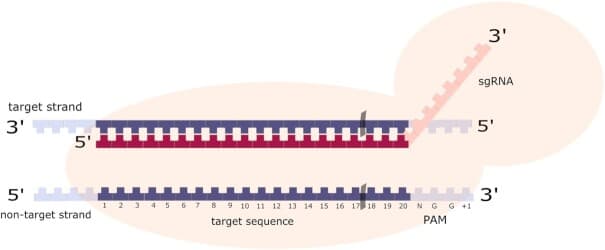
Figure 1. The CRISPR-Cas9 system: Cas9 protein in complex with sgRNA (gRNA domain in red, tracrRNA scaffold in pink) and target DNA. The 20-nt spacer at the 5' end of the gRNA directs Cas9 to the target; the NGG PAM site sits immediately downstream. The PAM-proximal 12 nt of the spacer (the seed region) must match the target precisely — mismatches here almost always abolish cutting. Adapted from Konstantakos V et al. (2022). CRISPR–Cas9 gRNA efficiency prediction: an overview of predictive tools and the role of deep learning. Nucleic Acids Research, 50(7). doi:10.1093/nar/gkac192, under CC BY 4.0.
On-target scoring algorithms — what they measure and why
Where Rule Set 2 (Azimuth) came from
Doench et al. 2016 ran a large-scale experiment: they synthesized ~18,000 guide RNAs targeting a set of essential human genes and measured each guide's activity in pooled dropout screens across multiple cell lines. Guides that efficiently disrupted their target gene caused cells to drop out of the pool. Guides that cut poorly didn't.
They then trained a regression model to predict guide activity from sequence features alone. The features the model learned to use:
- Dinucleotide context at each position. Not just the identity of the base at position N, but the pair of bases at N and N+1. Certain dinucleotides at specific positions consistently predicted high or low cutting. This is why two guides with identical GC content but different sequence context can score very differently.
- GC content. The model confirmed the empirical 40–70% rule but weighted specific positions more heavily — GC content in the seed region matters more than GC content at the PAM-distal end.
- Position within the gene. Guides near the 5' end of the coding sequence tend to score slightly higher for knockout applications. A frameshift early in the reading frame is more likely to produce a non-functional truncated protein than a frameshift near the stop codon.
This model is Rule Set 2, also called Azimuth. It's the most widely validated Cas9 on-target scoring model and the default in CRISPOR.
CRISPick and Rule Set 3
CRISPick (Broad Institute) implements Rule Set 3, an updated model trained with additional data including chromatin accessibility features for a subset of human cell types. In chromatin-accessible regions, guides tend to perform better than in compact heterochromatin — Azimuth was trained blind to this. If you're targeting a gene in a cell type with available ATAC-seq data, CRISPick's predictions may be more accurate.
For most applications — especially if you're working in common cell lines (HEK293, HeLa, K562, Jurkat) — either tool is appropriate. Use CRISPOR as the default; add CRISPick as a cross-check if you're seeing unexpectedly poor performance at your target locus.
What the score actually predicts — and what it doesn't
On-target scores predict average cutting efficiency in a population assay, across cell lines similar to the training data. They do not predict:
- Efficiency in your specific cell type (especially primary cells, hard-to-transfect cells, or non-human cells)
- Efficiency at a locus with unusual chromatin state (e.g., heavily methylated or very compact)
- Whether guide activity will produce the phenotypic outcome you're measuring
A score of 0.6 means: "in dropout screens in human cell lines, guides with this sequence context tend to cut well." It is a prior, not a guarantee. Real efficiency in your system will vary.
Practical threshold: Top-quartile guides in Azimuth typically score ≥0.5–0.6. Guides below 0.4 rarely perform well, and you should exhaust better options before falling back on them. This is also why you always test 3 guides per target — pick the top 3 candidates that survive all hard filters, and validate experimentally. If two fail, the third may work. If all three fail, the issue is probably chromatin accessibility or delivery, not guide design.
Off-target risk — seed region, specificity scores, and what to actually worry about
How off-target sites arise
Off-target cleavage occurs when a genomic sequence matches your spacer well enough in the seed region and has an NGG PAM nearby. The key asymmetry: Cas9 is much more tolerant of mismatches in the PAM-distal half of the spacer (positions 1–8 from the 5' end) than in the seed region (positions 9–20, PAM-proximal). A potential off-target with 3 mismatches all in positions 1–4 may cut at 30–50% the efficiency of your on-target. A potential off-target with 3 mismatches in the seed region will cut at near-zero efficiency.
This means total mismatch count is a poor proxy for off-target risk. You need to know where the mismatches fall.
CFD score (Doench 2016)
The Cutting Frequency Determination (CFD) score is the best-validated off-target metric available. It was derived from the same Doench 2016 dataset — the mismatch tolerance measurements were used to train a position-specific scoring matrix that predicts how much a given mismatch reduces cutting at a potential off-target site.
CRISPOR reports CFD scores for each predicted off-target site. The score ranges from 0 to 1, where 1 = expected to cut as well as the on-target, and 0.05 = expected to cut at 5% of the on-target rate.
Practical rule: Flag any predicted off-target with a CFD score >0.1. If a flagged site is in an annotated gene — particularly one involved in proliferation or DNA damage — examine it carefully before proceeding.
MIT specificity score (Hsu 2013)
The MIT score (from the Zhang lab's original CRISPR design tool) aggregates the predicted off-target risk for all predicted sites into a single 0–100 number. Higher = safer. It's less accurate than CFD for evaluating individual off-target sites, but it's a fast first-pass filter: guides scoring below 50 warrant closer inspection, and guides below 30 are high-risk in most applications.
MIT score is less accurate than CFD partly because it was derived from a smaller mismatch tolerance dataset and doesn't model position-specific effects as well. Use it as a summary; use CFD scores when you need to evaluate specific sites.
What level of off-target scrutiny is appropriate?
Off-target risk is not absolute — it depends heavily on your application:
- Basic research in immortalized cell lines (mechanistic knockouts, reporter assays): a guide with MIT score >70 and no high-CFD sites in annotated genes is generally acceptable. Off-target events at this frequency are unlikely to confound a clean phenotype.
- Primary cells or animal models: raise the bar. Consider Sanger sequencing or amplicon NGS at the top 3–5 predicted off-target sites before drawing conclusions from your phenotype.
- Therapeutic development: computational prediction alone is insufficient. Whole-genome off-target profiling (GUIDE-seq, CIRCLE-seq, or Digenome-seq — covered in Post 14) is standard practice. No CFD threshold substitutes for empirical genome-wide data when patient safety is at stake.
Reading CRISPOR output: a walkthrough for TP53 exon 5
Human TP53 exon 5 is one of the most frequently mutated regions in cancer — R175, G245, R248, R249, R273, R282 are the canonical hotspot codons. It's a well-characterized target, and CRISPOR returns a rich set of candidates.
Input: paste ~200 bp of the TP53 exon 5 genomic sequence (chr17:7,674,220–7,674,420, hg38) into CRISPOR at crispor.tefor.net, select Homo sapiens (hg38), SpCas9 / NGG PAM.
CRISPOR returns a table with one row per guide candidate. Here are the key columns and what to look for:
| Column | What it measures | Filter threshold |
|---|---|---|
| On-target score (Azimuth/Doench '16) | Predicted cutting efficiency (0–1) | ≥0.5 preferred; discard <0.4 unless no better option |
| Off-target score (MIT) | Aggregate off-target risk (0–100, higher = safer) | ≥70 for most applications |
| Out-of-frame score | Probability NHEJ indels are frameshift (for knockouts) | Higher is better for knockouts |
| GC% | GC content of the 20-nt spacer | 40–70% |
| Warnings | polyT run, strong hairpin, proximity to exon edge | Exclude any flagged guide |
The CFD scores for individual off-target sites appear in the expandable per-guide detail view. After shortlisting by the table columns above, click through to inspect off-target sites for your top candidates.
Example: filtering 5 candidates
A representative slice of what CRISPOR returns for TP53 exon 5:
| Guide | Spacer (5'→3') | GC% | On-target | MIT score | Warnings |
|---|---|---|---|---|---|
| g1 | GCACTGACAACCACCCTTAA | 50% | 0.64 | 81 | — |
| g2 | GTGCAGCTGTGGGTTGATTC | 60% | 0.58 | 74 | — |
| g3 | CCCAGCATCTTATCCGAGTG | 60% | 0.53 | 68 | — |
| g4 | TTTTGCAGATGACAGGCTGG | 45% | 0.61 | 72 | polyT (positions 1–4) |
| g5 | ACAGCCTGTGGTAATCTACT | 45% | 0.41 | 88 | — |
Filtering decisions:
- g4: excluded — polyT at positions 1–4 of the spacer will truncate U6-driven transcription.
- g5: excluded — on-target score 0.41 is below threshold; MIT score is high but efficiency is likely too low.
- g1, g2, g3: shortlisted. All pass GC%, on-target score, and MIT filters. Before finalizing, open each guide's detail view and check whether any predicted off-target site has CFD >0.1 in an annotated gene.
Result: shortlist g1, g2, g3 for bench testing. Order all three, test in parallel, validate by Sanger + TIDE (covered in Post 12).
Cas12a guide design — what changes
Post 2 covered the Cas12a mechanism. This section covers only what changes at the design level. Everything else — GC content, polyT, secondary structure checks — applies identically.
PAM orientation is reversed
SpCas9 reads NGG on the non-template strand, 3' of the spacer. AsCas12a and LbCas12a read a 5'-TTTV-3' PAM on the non-template strand, 5' of the spacer — upstream, not downstream.
In practice: when you scan a genomic sequence for Cas12a targets, you're looking for TTTA, TTTC, or TTTG on either strand, then reading the 23 nt downstream of that PAM as the spacer. Most design tools handle this automatically, but when you interpret tool output or manually check a target sequence, the PAM is always on the 5' side.
Spacer is 23 nt, not 20 nt
Cas12a contacts 23 nucleotides of target DNA. A 20-nt spacer — the default if you copy-paste from a Cas9 experiment — will underperform. This is one of the most common errors when switching from Cas9.
Seed region is at the 5' end of the spacer
Because the Cas12a PAM is 5' of the spacer, the PAM-proximal nucleotides are the first ~10 nt from the 5' end of the 23-nt spacer. This is the seed region for Cas12a. Mismatches here are most detrimental to cutting, and off-target sites with seed-region matches are the highest-risk hits — just as with Cas9, but at the other end of the spacer.
Scoring models are less mature
Rule Set 2 (Azimuth) was trained exclusively on SpCas9 data — applying it to a Cas12a spacer produces a meaningless prediction. Use tools with dedicated Cas12a models:
- CRISPOR: supports AsCas12a and LbCas12a with a Cas12a-specific scoring model
- CRISPick (Broad): has a Cas12a model for AsCas12a
- CHOPCHOP: supports Cas12a guide design
The Cas12a training datasets are smaller than the SpCas9 corpus, so scores are less reliable. Compensate by testing more candidates: shortlist 4–5 per target instead of 3.
Common mistakes
Testing only one guide per target. A single failed guide tells you that guide didn't work. It tells you nothing about whether the target locus is accessible, whether your delivery worked, or whether CRISPR is appropriate for your cell type. Always test 3 guides (or 4–5 for Cas12a). If all three fail, the problem is almost certainly upstream of guide design.
Treating all off-target mismatches equally. Two mismatches in the seed region (positions 9–20) represent a high off-target risk. Two mismatches in positions 1–4 (PAM-distal) represent a much lower risk — Cas9 tolerates these well. Always look at where mismatches fall in the CRISPOR off-target detail view, not just how many there are.
Using a Cas9 scoring tool for Cas12a guides. Rule Set 2 was trained on 20-nt SpCas9 spacers with NGG PAM context. It is the wrong model for a 23-nt Cas12a spacer with TTTV PAM. The output number will look like a score. It will not predict Cas12a guide activity.
Ignoring the polyT warning. A guide with TTTT anywhere in the spacer will be transcribed as a truncated RNA by U6-driven Pol III. It will look like a guide RNA. It won't cut reliably. CRISPOR flags these in red — check for flags before reading scores.
What's next
Post 6 covers gRNA design specifically for base editing. The rules from this post still apply, but base editing adds a constraint on top of them: your target cytosine (for CBE) or adenine (for ABE) must fall within the editing window — positions 4–8 for CBE, positions 4–7 for ABE, counting from the 5' end of the spacer. That window constraint often overrides the on-target score. A guide that scores 0.45 but places the target C cleanly in the window is more useful than a guide that scores 0.65 but positions the C at position 2 or position 12. Post 6 covers the tools (BE-Designer, PinPoint) that make this selection tractable.
→ Next: Designing gRNAs for base editing: hitting the right editing window
← Previous: Prime editing: how it works and when to use it over Cas9
Want the complete guide selection checklist, specificity scoring decision tree, and per-application off-target validation protocol? They're in the book CRISPR from Bench to Analysis.
Join the conversation
Are you designing guides for knockouts (where off-target risk tolerance is higher) or for precise edits or therapeutic work (where it's much lower)? And which tool do you reach for first — CRISPOR, CRISPick, or something else? Drop a comment below.
Resources
| Resource | What it's for | Link |
|---|---|---|
| CRISPOR | gRNA design + off-target prediction for Cas9 and Cas12a | crispor.tefor.net |
| CRISPick (Broad) | Rule Set 3 on-target scoring with chromatin features | broadinstitute.github.io/CRISPick |
| CHOPCHOP | gRNA design supporting Cas9 and Cas12a | chopchop.cbu.uib.no |
| Doench et al. 2016 | Rule Set 2 (Azimuth) and CFD score derivation | Nature Biotechnology 34:184–191 |
| Hsu et al. 2013 | MIT specificity score | Nature Biotechnology 31:827–832 |
| Moreno-Mateos et al. 2015 | CRISPRscan on-target scoring | Nature Methods 12:982–988 |
| Addgene CRISPR guide | Protocol reference and troubleshooting | addgene.org/guides/crispr |
| Konstantakos et al. 2022 | Source of Figure 1: gRNA efficiency prediction review | Nucleic Acids Research 50(7) |
Keep reading
On-target assessment methods compared: T7E1, TIDE, and amplicon NGS
You’ve made your edit, but how much of it is actually there? This post compares the three most common ways to measure CRISPR on-target efficiency—from the "quick and dirty" T7E1 gel assay to the high-resolution precision of Amplicon NGS.
Choosing your CRISPR system and designing validated guides: an end-to-end walkthrough
You have a gene to edit. Should you use Cas9, Cas12a, or a Base Editor? This capstone post walks you through the entire workflow—from choosing the right molecular "scissors" for your target to designing and validating your final guides.
In silico off-target prediction: how the algorithms work and which tools to trust
Choosing a guide RNA that cuts your target is only half the battle. You also need one that doesn’t cut anywhere else. This post breaks down the MIT and CFD scoring systems, how off-target algorithms actually work, and which tools are best for predicting Cas9 and Cas12a off-targets.