- Published on
- 32 min read
GUIDE-seq data analysis: the original pipeline, updated V2, and Palani simplified workflow
- Authors

- Name
- BioTech Bench
Table of contents
- What you'll learn
- Why GUIDE-seq reads don't look like standard Illumina libraries
- Pipeline 1: The original Joung/Aryee pipeline (aryeelab/guideseq)
- Pipeline 2: The updated Tsai Lab V2 pipeline (tsailabSJ/guideseq and GUIDE-seq-2)
- Pipeline 3: Nagendra Palani's simplified GUIDE-seq workflow (protocols.io.wikfccw)
- Head-to-head comparison: original vs. updated V2 vs. Palani simplified
- Limitations and caveats that no pipeline fixes
- Which GUIDE-seq workflow I'd pick today
- Resources
If you've ever sent your first GUIDE-seq library to a sequencing core, received two clean demultiplexed files named Sample1_R1.fastq.gz and Sample1_R2.fastq.gz, cloned the classic GitHub repository, and watched it crash before aligning a single read — welcome to one of the oldest rites of passage in CRISPR bioinformatics.
Most wet-lab protocols and bioinformatics pipelines treat library preparation and read processing as separate worlds. GUIDE-seq doesn't let you do that. Where your Unique Molecular Identifier (UMI) sits, which sequencing primer anneals to the double-stranded oligodeoxynucleotide (dsODN) tag, and how many bases remain between the 3' end of your PCR primer and the genomic double-strand break (DSB) junction are all baked directly into the code. Change a single overhang on the bench so your library can ride along on a shared NovaSeq lane, and an unmodified GUIDE-seq script will either crash, throw out half your reads as "mispriming," or look for cleavage sites on the wrong end of the DNA fragment.
In our comparison of cell-based and in vitro off-target assays, we covered why GUIDE-seq remains the go-to cell-based discovery assay for Cas9 specificity, and how it complements in silico off-target predictors like Cas-OFFinder. Here, we are going under the hood of the sequencing reads and running all three generations of the GUIDE-seq workflow end to end on real data:
- The original Joung/Aryee pipeline (
aryeelab/guideseq) from Tsai et al. (Nature Biotechnology 2015/2016) - The updated Tsai Lab V2 pipeline (
tsailabSJ/guideseqand GUIDE-seq-2) from Malinin et al. (Nature Protocols 2021) and Lazzarotto et al. (2025) - Nagendra Palani's simplified GUIDE-seq workflow (
protocols.io.wikfccw), including a ready-to-run preprocessing script and YAML configuration that fixes three silent read-loss traps when analyzing inline-UMI libraries
What you'll learn
- How GUIDE-seq read geometry actually works, why raw PCR read counts can't measure cleavage rates without UMIs, and why bidirectional (
+and-) dsODN capture separates Cas9 cuts from background DNA breaks - How the original
aryeelab/guideseqpipeline runs, including the two legacy Python 2.7 / submodule bugs you'll hit if you clonemastertoday and how to patch them in thirty seconds - What changed in
tsailabSJ/guideseqV2 and GUIDE-seq-2, fromUMI-toolspost-alignment deduplication and ENCODE blacklist filtering to residual-dsODN mispriming detection and Tn5 tagmentation - How Nagendra Palani's simplified protocol (
protocols.io.wikfccw) redesigns the library so you can sequence on any standard Illumina2×150lane without custom index recipes or a Covaris sonicator - How to convert Palani inline-UMI FASTQs for
tsailabSJ/guideseq, whyRead 1andRead 2must be swapped, and why leaving the defaulti7+primer setting in your YAML silently wipes out 95% of your antisense primer counts
Why GUIDE-seq reads don't look like standard Illumina libraries
To understand why three different GUIDE-seq pipelines exist, look at what the assay actually builds in a tube. When you nucleofect cells with Cas9 ribonucleoprotein (RNP) alongside a blunt, 5'-phosphorylated, phosphorothioate-protected 34-bp dsODN (5'-G*T*TTAATTGAGTTGTCATATGTTAATAACGG*T*A*T-3'), the cell's non-homologous end joining (NHEJ) machinery occasionally captures that short duplex right inside open double-strand breaks.
Because the dsODN is blunt-ended, it integrates in either orientation (+ sense or - antisense) at the break, and you can amplify outward from the integrated tag into both the upstream and downstream genomic flanks. You split each sample's sheared genomic DNA into two separate hemi-specific PCR reactions — one primed off the sense strand of the tag and one primed off the antisense strand — pairing a tag-specific primer on one side with a universal adapter primer ligated to randomly fragmented genomic DNA on the other.
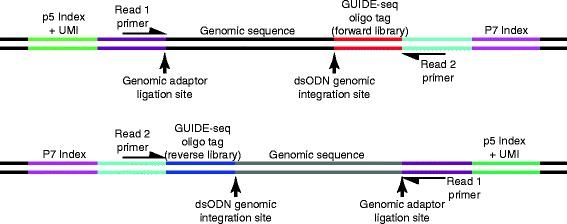
Figure 1. Classic GUIDE-seq forward and reverse sequencing library architecture. Read 1 starts at the sheared genomic adapter ligation junction, Read 2 starts inside the integrated dsODN tag and sequences across the Cas9 double-strand break junction, and the P5 sample index plus UMI sit together on the P5 end. Adapted from Zhu LJ et al. (2017). GUIDEseq: a bioconductor package to analyze GUIDE-Seq datasets for CRISPR-Cas nucleases. _BMC Genomics_, 18:379. doi:10.1186/s12864-017-3746-y, under CC BY 4.0.
Look closely at Figure 1, because two rules in that diagram drive every line of GUIDE-seq code:
- Read 2 pins the exact Cas9 cut site; Read 1 + the UMI count unique starting cells. Every copy amplified from a single cleaved chromosome starts at the exact same nucleotide at the dsODN junction (Read 2), so standard coordinate-only PCR deduplication (
samtools markdupon Read 2 alone) would collapse thousands of independent editing events into one read. You need the random shear/tagmentation endpoint on Read 1 paired with a random UMI to distinguish 500 edited cells from 500 PCR copies of one cell. - True Cas9 cuts produce a tight, bidirectional pileup. Spontaneous fragile-site breaks and PCR mispriming almost always land on one strand in one orientation. A genuine Cas9 blunt cut integrates the dsODN in both orientations and amplifies into both flanks, producing
+and-UMI clusters stacked within a 10-bp window right at the cleavage site (3 bp upstream of the PAM for SpCas9).
Where the three workflows diverge is how they attach that UMI and adapter — and what the sequencer hands back to you as a result.
Pipeline 1: The original Joung/Aryee pipeline (aryeelab/guideseq)
When Shengdar Tsai, Martin Aryee, and J. Keith Joung published GUIDE-seq (Tsai et al., Nature Biotechnology 2015) and its companion Python package (Tsai et al., Nature Biotechnology 2016), they built the library using Covaris acoustic shearing (~500 bp), end-repair, dA-tailing, and ligation of 16 custom barcoded Y-adapters (A01–A16). Each Y-adapter carried an 8-bp P5 sample barcode immediately followed by an 8-bp random UMI (NNNNNNNN).
Why the original protocol clashed with sequencing cores
Because that 8-bp UMI sat directly behind the 8-bp P5 sample index, the sequencer had to read 16 cycles in Index 2 (I2) — a 151 | 8 | 16 | 151 run recipe (R1 | I1 | I2 | R2). Standard Illumina MiSeq and NextSeq workflows don't emit FASTQ files for index reads by default, and standard bcl2fastq demultiplexing fails if you feed 8 random UMI bases into a sample sheet barcode column.
To run the original pipeline, you had to edit Miseq Reporter.exe.config on the instrument (<add key="CreateFastqForIndexReads" value="1">) or ask your genomics core to dump four raw, undemultiplexed files: undemux.r1.fastq.gz, undemux.r2.fastq.gz, undemux.i1.fastq.gz, and undemux.i2.fastq.gz.
From there, aryeelab/guideseq runs seven sequential steps (guideseq.py all -m manifest.yaml):
demultiplex: Concatenatesbarcode1[1:8] + barcode2[1:8]and splits the four pooled files into per-sampler1,r2,i1, andi2FASTQs using an exact 0-mismatch string match.umitag: Extracts bases8:16ofI2(the 8-bp UMI) and concatenates it with the first 6 bases ofR1and the first 6 bases ofR2(UMI_R1[:6]_R2[:6]), sorting the FASTQ files by molecular tag.consolidate: Before mapping anything to the genome, iterates over each molecular-ID bin withHTSeqand calls a base-by-base consensus read (requiring base quality> 15and allele frequency> 0.9, masking ties asN).align: Maps the consolidatedR1andR2reads to the reference genome withbwa mem.identify: Filters forRead 2(sam_flag & 128,MAPQ >= 50), merges cleavage positions within a 10-bp sliding window, keeps windows where eitherbi.geometric_mean.mi > 0(reads on both+and-strands) orprimer.geometric_mean > 0(both senseprimer1and antisenseprimer2tags), extracts±25 bpof reference sequence, and runs a fuzzy regex local alignment (regex.BESTMATCH) allowing up to 6–7 mismatches or 1 DNA/RNA bulge (scoring an indel bulge as 3 mismatches).filter: Runsbedtools intersectagainst a pooledcontrol(dsODN-only mock) sample to flag background DSBs.visualize: Draws a color-coded.svgalignment grid of all off-targets withsvgwrite.
Running aryeelab/guideseq today (and fixing two repo bugs)
If you need to reproduce a legacy analysis with aryeelab/guideseq, you have to build an isolated Python 2.7 Conda environment (HTSeq in consolidate.py calls .decode('utf-8') on read.seq, which fails on Python 3 str objects). Even inside Python 2.7, two traps in the GitHub repository trip people up immediately:
- You must clone with
--recursive. Thedemultiplex,umitag, andconsolidatemodules live in a separate Git submodule (aryeelab/umi). Plaingit cloneleavesguideseq/umi/empty and crashes withImportError: No module named umi. - Line 439 of
identifyOfftargetSites.pyhas a broken Python 3 edit (str.maketrans). A partial Python 3 commit onmasterreplacedstring.maketranswithstr.maketrans, which crashes Python 2.7 right after BWA finishes aligning (AttributeError: type object 'str' has no attribute 'maketrans'). Adding a version check (string.maketranson Python 2,str.maketranson Python 3) fixes it cleanly.
Let's set up the environment, inspect our manifest_original.yaml for the classic EMX1 benchmark dataset (GAGTCCGAGCAGAAGAAGAANGG), and run aryeelab/guideseq end to end:
# Create an isolated Python 2.7 environment for legacy aryeelab/guideseq
conda create -n guideseq_py27 -c conda-forge -c bioconda \
  python=2.7 bwa=0.7.18 bedtools=2.31.1 samtools=1.18 \
  htseq=0.11.3 pysam=0.20.0 pyfaidx=0.7.0 pyyaml=5.3.1 \
  svgwrite=1.3.1 regex=2020.2.20 numpy=1.16.5 -y

# Clone WITH --recursive so guideseq/umi is populated
git clone --recursive https://github.com/aryeelab/guideseq.git aryeelab_guideseq
Here is the manifest (manifest_original.yaml) pointing at the undemultiplexed EMX1 + mock control FASTQs:
reference_genome: test_genome.fa
output_folder: output

bwa: bwa
bedtools: bedtools

demultiplex_min_reads: 1000
search_radius: 25
max_score: 7

undemultiplexed:
  forward: data/undemultiplexed/undemux.r1.fastq.gz
  reverse: data/undemultiplexed/undemux.r2.fastq.gz
  index1: data/undemultiplexed/undemux.i1.fastq.gz
  index2: data/undemultiplexed/undemux.i2.fastq.gz

samples:
  control:
    target:
    barcode1: CTCTCTAC
    barcode2: CTCTCTAT
    description: Control

  EMX1:
    target: GAGTCCGAGCAGAAGAAGAANGG
    barcode1: TAGGCATG
    barcode2: TAGATCGC
    description: EMX1_site1
After patching reverseComplement() in guideseq/identifyOfftargetSites.py to use string.maketrans under Python 2, let's run the full 7-step pipeline and inspect the log:
conda run -n guideseq_py27 python aryeelab_guideseq/guideseq/guideseq.py all -m manifest_original.yaml
[11/25 07:59:45PM][INFO][guideseq] Loading manifest...
[11/25 07:59:45PM][INFO][guideseq] Successfully loaded manifest.
[11/25 07:59:45PM][INFO][guideseq] Demultiplexing undemultiplexed files...
[11/25 07:59:45PM][INFO][demultiplex] Wrote FASTQs for the 2 sample barcodes out of 3 with at least 1000 reads.
[11/25 07:59:45PM][INFO][guideseq] Successfully demultiplexed reads.
[11/25 07:59:45PM][INFO][guideseq] umitagging reads...
[11/25 07:59:46PM][INFO][guideseq] Successfully umitagged reads.
[11/25 07:59:46PM][INFO][guideseq] Consolidating reads...
[11/25 07:59:46PM][INFO][consolidate] Consolidating reads in output/umitagged/control.r1.umitagged.fastq
[11/25 07:59:47PM][INFO][consolidate] Read 1615 input reads
[11/25 07:59:47PM][INFO][consolidate] Wrote 943 consolidated reads to output/consolidated/control.r1.consolidated.fastq
[11/25 07:59:47PM][INFO][consolidate] Successfully consolidated 128623 bases out of 142393 (90.33%)
[11/25 07:59:49PM][INFO][consolidate] Consolidating reads in output/umitagged/EMX1.r1.umitagged.fastq
[11/25 07:59:53PM][INFO][consolidate] Read 6000 input reads
[11/25 07:59:53PM][INFO][consolidate] Wrote 2389 consolidated reads to output/consolidated/EMX1.r1.consolidated.fastq
[11/25 07:59:53PM][INFO][consolidate] Successfully consolidated 328174 bases out of 360739 (90.97%)
[11/25 07:59:56PM][INFO][guideseq] Successfully consolidated reads.
[11/25 07:59:57PM][INFO][guideseq] Finished aligning reads to genome.
[11/25 08:03:30PM][INFO][guideseq] Identifying offtarget sites...
[11/25 08:03:30PM][INFO][identifyOfftargetSites] Processing SAM file output/aligned/control.sam
[11/25 08:03:30PM][INFO][identifyOfftargetSites] Processing SAM file output/aligned/EMX1.sam
[11/25 08:03:30PM][INFO][guideseq] Finished identifying offtarget sites.
[11/25 08:03:30PM][INFO][guideseq] Filtering background sites
[11/25 08:03:30PM][INFO][guideseq] Finished visualizing off-target sites
Notice how much PCR duplication was hiding inside those raw EMX1 reads: 6,000 raw read pairs collapsed down to 2,389 unique molecular templates (2.5× PCR redundancy). Let's inspect the core columns of output/identified/EMX1_identifiedOfftargets.txt:
cut -f1,6,8,9,10,16,17,20,21,22 output/identified/EMX1_identifiedOfftargets.txt
Chromosome	Position	+.mi	-.mi	bi.sum.mi	primer1.mi	primer2.mi	Site_SubstitutionsOnly.Sequence	Site_SubstitutionsOnly.NumSubstitutions	Site_SubstitutionsOnly.Strand
15:44108746-44110769	1017	116	73	189	96	80	GAGTCTAAGCAGAAGAAGAAGAG	3	+
1:236259170-236261754	1233	2	0	2	1	1
1:236259170-236261754	1539	0	3	3	1	1
2:73159981-73162004	1017	243	246	489	236	231	GAGTCCGAGCAGAAGAAGAAGGG	0	+
3:197899267-197901348	1080	0	8	8	7	1
6:9117792-9119815	1007	1	3	4	2	2	ACGTCTGAGCAGAAGAAGAATGG	3	-
Three windows align cleanly to the EMX1 protospacer:
- On-target EMX1 (
chr2, 0 mismatches,GAGTCCGAGCAGAAGAAGAAGGG):243+UMIs and246-UMIs (bi.sum.mi = 489), balanced almost 50:50 across both strands and both dsODN primers (236vs.231). - Major off-target (
chr15, 3 mismatches,GAGTCTAAGCAGAAGAAGAAGAG):189bidirectional UMIs (+116/-73), including a non-canonicalNAG(GAG) PAM that Cas9 still cleaves at nearly 39% of the on-target GUIDE-seq count. - Minor off-target (
chr6, 3 mismatches,ACGTCTGAGCAGAAGAAGAATGG):4bidirectional UMIs (+1/-3).
Look at the remaining three rows (1:236259170 and 3:197899267, telomeric TTAGGG repeats) where Site_SubstitutionsOnly.Sequence is blank. Those are genomic windows that cleared primer.geometric_mean > 0 (1 read from each primer) without matching the gRNA within 7 mismatches. And if you look at Name inside the full EMX1_identifiedOfftargets.txt file on UCSC hg38 FASTAs where chromosomes already start with chr, line 133 of aryeelab/guideseq unconditionally prepends "chr" + chromosome, turning chr2 into chrchr2 and breaking bedtools intersect. That is one of many reasons Shengdar Tsai's group rewrote the pipeline.
Pipeline 2: The updated Tsai Lab V2 pipeline (tsailabSJ/guideseq and GUIDE-seq-2)
After moving to St. Jude Children's Research Hospital, Shengdar Tsai's group published the definitive step-by-step bench protocol (Malinin et al., Nature Protocols 2021), overhauled the software in tsailabSJ/guideseq (internally labeled guideseq_V2), and introduced GUIDE-seq-2 (Lazzarotto et al., bioRxiv 2025).
What changed on the bench (GUIDE-seq-2) and in the code (tsailabSJ/guideseq)
On the wet-lab side, GUIDE-seq-2 replaces Covaris sonication, end-repair, dA-tailing, Y-adapter ligation, and the two nested PCR rounds with single-tube Tn5 transposome tagmentation carrying a 10-bp UMI (i2[-10:] in an 18-cycle I2 read) followed by a single round of PCR. That cuts library prep down to a plate-friendly reaction that scales to hundreds of samples.
On the computational side, tsailabSJ/guideseq V2 upgrades five critical parts of the original aryeelab codebase:
- Python 3, Docker (
liyc1989/tsailabsj), and cluster parallelization: Runs under Python 3 either locally (guideseq.py main -m manifest.yaml) or across LSF cluster nodes (guideseq.py parallel -m manifest.yaml), and fixes thechrchrUCSC chromosome bug. - 1-mismatch Hamming demultiplexing and per-sample paired controls: Instead of 0-mismatch concatenation and a single shared
controlblock,demultiplex.pyallowsmismatch: 1per index and pairs each treatment sample directly with its own matched mock control (controlbarcode1andcontrolbarcode2). - Post-alignment BAM deduplication with
UMI-tools: Instead of slow customHTSeqFASTQ sorting before alignment, V2 appends_UMIto the read name, aligns all pairs withbwa mem, sorts withsamtools, and runsumi_tools dedup --method unique --pairedusing both genomic coordinates and the UMI. - Explicit residual-dsODN mispriming detection: This is the biggest accuracy upgrade in V2. In PCR, the tag primer (
i7-: 29-bpGTTTAATTGAGTTGTCATATGTTAATAAC;i7+: 22-bpATACCGTTATTAACATATGACA) doesn't reach the very 3' end of the 34-bp dsODN. A genuine dsODN integration must still show the un-primered 3' tail of the tag (GGTAT, 5 bp fori7-;ACTCAATTAAAC, 12 bp fori7+) right before genomic DNA begins. If a primer annealed directly to a partial match in human genomic DNA (mispriming), those residual dsODN bases won't be there. V2 checks the Levenshtein edit distance of that residual tail and quarantines misprimed reads intoprimer1_mispriming.miandprimer2_mispriming.miso they don't create false-positive peaks. - Multi-stage blacklist and control filtering: Automatically strips ENCODE blacklist regions (
hg38-blacklist.v2.bed.gz→.rmblck.txt) and annotates nearby mock-control counts viabedtools closest(.rmblck.with_control_counts.txt).
Python version note if you install outside Docker:
tsailabSJ/guideseqcallsyaml.load(f)without aLoaderargument and opens SAM files with Python's legacy'rU'universal-newline mode. Both were removed inPyYAML >= 6.0andPython >= 3.11. Either run the official container (docker.io/liyc1989/tsailabsj), or pin Python 3.9 andpyyaml==5.3.1in Conda/uvas shown below.
Running tsailabSJ/guideseq V2 on AAVS1 site 14
Let's inspect the raw read structure from the Tsai Lab's AAVS1 site 14 (GGGGCCACTAGGGACAGGATNGG) dataset before running V2. Look at the fourth read record across R2 and I2:
sed -n '13,16p' test_fastq_R2_001.fastq
@NB551526:253:HF3TGBGXN:1:11101:19625:3111 2:N:0:CCTGAGGA+ACACTTTCGACTCCTTAC
GTTTAATTGAGTTGTCATATGTTAACGGTATGTCCCTAGTGGCCCCACTGTGGGGTGGAGGGGACCTGTCTCTTATACACATATGACGCTGCCGACGAACACTTTCGACTCCTTACGTGTAGATCTCGGTGGTCGCCGTATCATTA
+
AAAAAEEEAEEA<AE/EEA/6AA/EE//EEA/EEEEEEAEEEEAEEAEE/E//E////EE///E<AEEE//EA<////<</</E/EEEEEE<EA<<<AAEAE//EEA/E/AEE</EE//AE/EE/EE////AEE/EE/EEE<<//<
sed -n '13,16p' test_fastq_I2_001.fastq
@NB551526:253:HF3TGBGXN:1:11101:19625:3111 2:N:0:CCTGAGGA+ACACTTTCGACTCCTTAC
GTAAGGAGTCGAAAGTGT
+
/AAA/EE66EAA6AA/AA
You can read the entire GUIDE-seq-2 molecular biology right off those two strings:
- In
test_fastq_I2_001.fastq(18 bp), bases 1–8 (GTAAGGAG) arebarcode2, and the last 10 bases (TCGAAAGTGT) are the 10-bp Tn5 UMI. - In
test_fastq_R2_001.fastq, bases 1–31 (GTTTAATTGAGTTGTCATATGTTAACGGTAT) are the integrated dsODN (including the residualGGTATtail!), followed immediately at base 32 byGTCCCTAGTGGCCCCACTGT...— the exact reverse-complement of AAVS1 site 14 split right at the SpCas9 cut site 3 bp upstream of the PAM, and ending inCTGTCTCTTATACACATCT(the Tn5 Mosaic End where the transposome tagmented a short fragment).
Let's run tsailabSJ/guideseq V2 across demultiplex, align, and identify:
python tsailab_guideseq/guideseq/guideseq.py main \
  -m manifest_updated.yaml \
  --step demultiplex+align+identify
Let's check the UMI-tools deduplication summary at the bottom of aligned/AAVS1_site_14.dedup.log:
tail -n 6 aligned/AAVS1_site_14.dedup.log
2026-11-25 20:01:16,118 INFO Reads: Input Reads: 9551, Read pairs: 9551, Read 1 unmapped: 8
2026-11-25 20:01:16,118 INFO Number of reads out: 9505
2026-11-25 20:01:16,118 INFO Total number of positions deduplicated: 2737
2026-11-25 20:01:16,118 INFO Mean number of unique UMIs per position: 3.47
2026-11-25 20:01:16,118 INFO Max. number of unique UMIs per position: 162
# job finished in 0 seconds at Wed Nov 25 20:01:16 2026 --  6.36  0.61  0.00  0.01 -- aa8903ef-50a5-41eb-9693-901a8d3fb4a9
Now let's inspect the blacklist-filtered candidate table (identified/AAVS1_site_14_identifiedOfftargets.rmblck.txt):
cut -f1,8,10,11,12,18,19,20,21,27,28,32,34 identified/AAVS1_site_14_identifiedOfftargets.rmblck.txt
#BED_Chromosome	Position	+.mi	-.mi	bi.sum.mi	primer1.mi	primer2.mi	primer1_mispriming.mi	primer2_mispriming.mi	Site_SubstitutionsOnly.Sequence	Site_SubstitutionsOnly.NumSubstitutions	Site_GapsAllowed.Sequence	Site_GapsAllowed.Score
chr19	13795388	8	0	8	7	1	0	0	GGGGCCAATAGGGACAGGCGGTG	4
chr19	16064183	323	227	550	342	151	22	13	GGGGCTTCTAAGGACAGGATGGG	3
chr19	18765175	2	8	10	7	2	1	0
chr19	2571945	17	49	66	50	8	1	5			TAGGCCAAT-GGGACAGGATAGG	6
chr19	45172703	23	1	24	11	2	11	0	GCTGGGCCAGGGGACAGGATGGG	7
chr19	45929474	19	24	43	37	5	0	0	GGGGGACAGAGGGACAGGATGGG	5	GGGGACAG-AGGGACAGGATGGG	5
chr19	48749680	3	2	5	3	2	0	0	AGGGCCCTTATGGACAGGATGGG	4
chr19	55115669	0	3	3	1	1	1	0
chr19	55115755	4416	2474	6890	4628	1341	647	84	GGGGCCACTAGGGACAGGATTGG	0
Look how much richer V2's output table is compared to the 2015 pipeline:
- Gapped (RNA/DNA bulge) off-targets are caught automatically: Look at
chr19:2,571,945(bi.sum.mi = 66,+17/-49). Ungapped alignment (Site_SubstitutionsOnly.Sequence) is blank because without a gap it exceeds 7 mismatches — yetSite_GapsAllowed.SequencecatchesTAGGCCAAT-GGGACAGGATAGG(3 substitutions + 1 RNA-bulge deletion,Score = 3 + 1×3 = 6). If your off-target pipeline ignores 1-nt bulges, you miss the third strongest cleavage site on the chromosome. - Mispriming molecules are separated out: At the on-target locus (
chr19:55,115,755,bi.sum.mi = 6,890) and atchr19:45,172,703(11validprimer1.mivs.11primer1_mispriming.mi), V2 tracks reads whose residual dsODN sequence diverged fromGGTATorACTCAATTAAAC. - Note on
visualizewithout HOMER: If you run--step visualizeoutside the Tsai Lab Docker image without HOMER (annotatePeaks.pl) installed,visualization.pythrowspandas.errors.EmptyDataErrorwhen trying to parse the empty.raw.homer.tsvannotation file. In practice, plotting directly in R withggplot2from.rmblck.txtgives you cleaner figures without fighting HOMER's Perl setup.
Here is a quick R snippet using ggplot2 and dplyr to plot the bidirectional + and - UMI counts across all seven sequence-matched AAVS1 cleavage sites:
library(ggplot2)
library(dplyr)

hdr <- sub("^#", "", strsplit(readLines("identified/AAVS1_site_14_identifiedOfftargets.rmblck.txt", n = 1), "\t")[[1]])
gs <- read.delim("identified/AAVS1_site_14_identifiedOfftargets.rmblck.txt", header = FALSE, skip = 1, col.names = hdr)

matched <- gs %>%
  filter(Site_SubstitutionsOnly.Sequence != "" | Site_GapsAllowed.Sequence != "") %>%
  arrange(desc(bi.sum.mi)) %>%
  select(BED_Chromosome, Position, `+.mi`, `-.mi`, bi.sum.mi,
         Site_SubstitutionsOnly.NumSubstitutions, Site_GapsAllowed.Sequence)

print(matched)
  BED_Chromosome Position +.mi -.mi bi.sum.mi Site_SubstitutionsOnly.NumSubstitutions Site_GapsAllowed.Sequence
1          chr19 55115755 4416 2474      6890                                       0
2          chr19 16064183  323  227       550                                       3
3          chr19  2571945   17   49        66                                      NA   TAGGCCAAT-GGGACAGGATAGG
4          chr19 45929474   19   24        43                                       5   GGGGACAG-AGGGACAGGATGGG
5          chr19 45172703   23    1        24                                       7
6          chr19 13795388    8    0         8                                       4
7          chr19 48749680    3    2         5                                       4
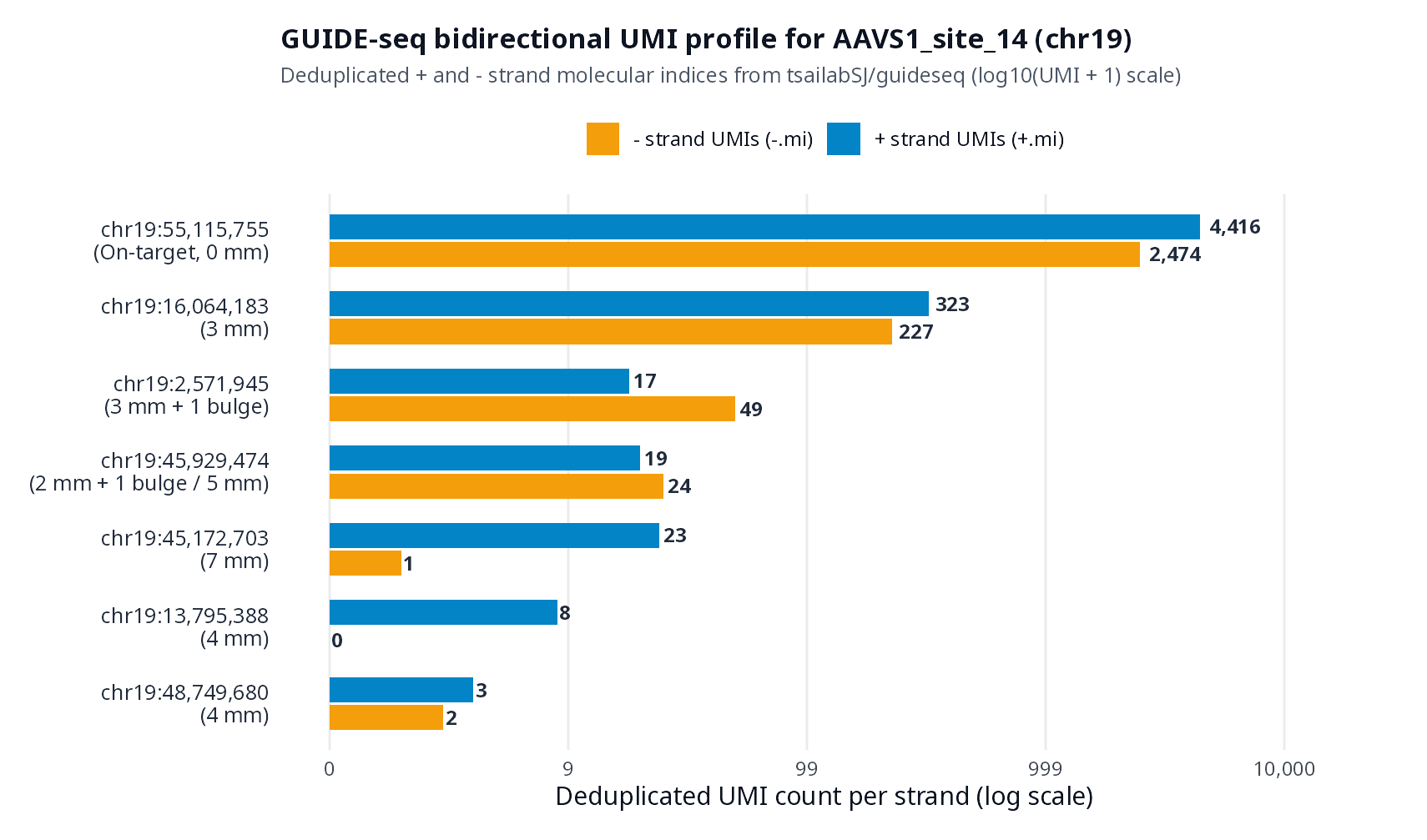
Figure 2. Bidirectional + and - strand deduplicated UMI profile across the seven sequence-matched cleavage sites on chr19 for AAVS1_site_14, spanning four orders of magnitude from the on-target locus (6,890 UMIs) down to a 4-mismatch off-target (5 UMIs). Output of our tsailabSJ/guideseq V2 run and R plotting script.
Pipeline 3: Nagendra Palani's simplified GUIDE-seq workflow (protocols.io.wikfccw)
Even with tsailabSJ/guideseq V2, there is still a practical catch for academic labs and small biotech teams: both classic GUIDE-seq (16-bp I2) and GUIDE-seq-2 (18-bp I2 + custom UMI-Tn5 transposomes) expect custom index-read lengths and undemultiplexed I1/I2 FASTQ files. If you only have four or eight GUIDE-seq libraries and want to pool them onto a shared institutional NextSeq 2000 or commercial NovaSeq X lane (2×150 bp, standard 8-bp or 10-bp dual indexes), your sequencing provider won't reconfigure the entire flow cell's RunInfo.xml for your 2% spike-in.
That is the exact problem Nagendra Palani (University of Minnesota Genomics Center) solved in his widely adopted Simplified GUIDE-seq Library Preparation Protocol (Palani, protocols.io, doi:10.17504/protocols.io.wikfccw).
How Palani re-engineered the library chemistry
Palani made three smart changes to the bench protocol:
- One-pot enzymatic fragmentation (
NEBNext Ultra II FS) replaces Covaris acoustic shearing, end-repair, and dA-tailing in a single tube. - One universal Nextera-compatible Y-adapter (
TA_Adaptor) replaces all 16 barcoded adapters — and moves the 8-bp UMI (NNNNNNNN) inline into Read 2 right behind the Nextera Read 2 sequencing primer:TA_Adaptor_Top:5'-/5Phos/CTCACCGCTCTTGTAGS NNNNNNNN CTGTCTCTTATACACATCTCCGAG*C-3'TA_Adaptor_Bottom:5'-CTACAAGAGCGGTGAGT-3'
- Nextera overhang enrichment in PCR1 + standard dual indexing in PCR2:
dsODN_Enrich_Plus:5'-TCGTCGGCAGCGTCAGATGTGTATAAGAGACAG NNN GTTTAATTGAGTTGTCATATGTTAATAACG*G-3'dsODN_Enrich_Minus:5'-TCGTCGGCAGCGTCAGATGTGTATAAGAGACAG NNN CCGTTATTAACATATGACAACTCAATTAAA*C-3'dsODN_Enrich_Adaptor:5'-GTCTCGTGGGCTCGGAGATGTGTATAAGAGACA*G-3'
Because PCR2 adds ordinary Nextera i5 and i7 sample barcodes, your library sequences on any standard Illumina 2×150 run, and bcl2fastq or BCL Convert hands you normal demultiplexed Sample_R1.fastq.gz and Sample_R2.fastq.gz files. Even the NNN bases in dsODN_Enrich_Plus/Minus are thoughtfully placed: they stagger the constant dsODN sequence across cycles 1–3 of Read 1 so two-color NovaSeq/NextSeq optics don't lose cluster registration from low base diversity.
The three bioinformatic traps in Palani FASTQ files
Here is where labs get burned. When your core hands back Sample_R1.fastq.gz and Sample_R2.fastq.gz from a Palani prep and you try to feed them into aryeelab/guideseq or tsailabSJ/guideseq, three molecular differences break the default pipeline:
- Read 1 and Read 2 are swapped relative to Tsai/Aryee GUIDE-seq. Look at the Nextera overhangs on Palani's primers:
dsODN_Enrich_PlusanddsODN_Enrich_MinuscarryTCGTCGGCAGCGTC...(the Nextera Read 1 / P5 overhang), whileTA_Adaptor_Topcarries...CTGTCTCTTATACACATCTCCGAGC(the Nextera Read 2 / P7 overhang). That means Palani's Read 1 is the dsODN cleavage junction (starting with the3-bp NNN stagger), and Palani's Read 2 is the sheared genomic end! Botharyeelab/guideseqandtsailabSJ/guideseqhardcodeint(sam_flag) & 128(Read 2) when scanning the SAM file for dsODN tags and DSB coordinates. Feed PalaniR1andR2in un-swapped, and the pipeline looks for dsODN primers on the randomly fragmented adapter end and calls zero sites. - Read 2 starts with a 26-bp inline UMI + adapter stem. Cycles 1–8 of Palani Read 2 are the 8-bp UMI (
NNNNNNNN), followed immediately byS(CorG) +CTACAAGAGCGGTGAGT(18 bpof universalTA_Adaptorstem) before genomic DNA begins at base 27. You must extract bases 1–8 into the read header (@READID_UMI) and trim all 26 leading bases off Read 2 beforebwa mem, while trimming the 3-bpNNNstagger off Read 1. - Palani's
dsODN_Enrich_Minusprimer failstsailabSJ/guideseq's defaulti7+check. Look at the 5' start of the antisense dsODN (5'-ATACCGTTATTAACATATGACAACTCAATTAAAC-3'). Tsai's defaulti7+setting indefault.yamlchecks the first 22 bases againstATACCGTTATTAACATATGACA(i7+_match_distance: 2). Palani'sdsODN_Enrich_Minusprimer (CCGTTATTAACATATGACAACTCAATTAAAC) starts 3 bp further inward (CCGTTATTA..., skippingATA) and extends all the way to the 3' end of the tag! WhentsailabSJ/guideseqcomparesCCGTTATTAACATATGACAACTtoATACCGTTATTAACATATGACA, the Levenshtein edit distance is 6 (> 2), causing V2 to classify almost every antisense dsODN read asnomatch!
Step-by-step: Converting and analyzing Palani libraries with tsailabSJ/guideseq
To test this cleanly head to head, I took the exact 9,577 AAVS1 treatment read pairs and 1,806 mock control read pairs from the St. Jude AAVS1 dataset and formatted them into Palani's exact protocols.io.wikfccw read geometry (AAVS1_Palani_R1.fastq.gz and AAVS1_Palani_R2.fastq.gz). Let's preview the first raw read pair as it comes off standard Illumina demultiplexing:
zcat raw_illumina/AAVS1_Palani_R1.fastq.gz | head -n 4
@NB551526:253:HF3TGBGXN:1:11101:13690:1710 1:N:0:TAAGGCGA+CTCTCTAT
ACGGTTTAATTGAGTTGTCATATGTTAATAACGGTAAAGAGACAGCTACGTTTTATTTTTTATTTTTTAACTTTGAATTTAAGTATTGTTGCCCAGGCTGGAGTGCAATGGCGCATTCATGGGCTAACTGGCGCCTCTGCCTACAAGGT
+
EEEAAAAAEEEEEEEEEEEEEEAAEEEEEEEEEEEE6E66/E/AA/A///EEEA//E///EEE/EEA/AE//<//EE//A/////EEA/E//6/<6EAEE/E////EE/A//EEA/E</EE/</A//AA/E//<AEE/</EE///////
zcat raw_illumina/AAVS1_Palani_R2.fastq.gz | head -n 4
@NB551526:253:HF3TGBGXN:1:11101:13690:1710 2:N:0:TAAGGCGA+CTCTCTAT
GGATACGACCTACAAGAGCGGTGAGTCTAAAAATACAAAAATTAGCTGGGCATGATGGTGGGTGCCTGTAATGCCAGCTACCTTGAATGCTGAGGCAGGAGAATTGCATGATCATCGGAGGCAGAGGCTCAAGTGAGCCCAAGATTGCGC
+
A/EAA///EEEEEEEEEEEEEEEEEEAAAAAE///AAA/EAEEAA////E/EA/EEE6A//EE/A6EAE//E<</E//E6A<EEE6E/A/EAEA//E/6EEEEEE/<///E/E/E///A////AEEAEE//EE/<A/E/EE/<<////A6
Look at the 5' ends: R1 starts with ACG (3-bp stagger) + GTTTAATTG... (dsODN), while R2 starts with GGATACGA (8-bp UMI) + CCTACAAGAGCGGTGAGT (18-bp TA_Adaptor stem) + CTAAAAATAC... (sheared genomic DNA).
Here is a self-contained Python 3 script (palani_to_guideseq.py) — zero external dependencies — that extracts the 8-bp UMI into _UMI headers, verifies and trims the 26-bp TA_Adaptor prefix from R2, trims the 3-bp NNN stagger from R1, and swaps R1 ↔ R2 into demultiplexed/<sample>.r1.fastq and <sample>.r2.fastq:
#!/usr/bin/env python3
"""Convert demultiplexed Palani (protocols.io.wikfccw) FASTQs for tsailabSJ/guideseq."""
import argparse
import gzip
import os


def open_fq(path):
    return gzip.open(path, "rt") if path.endswith(".gz") else open(path, "rt")


def fq_iter(handle):
    while True:
        h = handle.readline()
        if not h:
            break
        yield h.rstrip("\r\n"), handle.readline().rstrip("\r\n"), handle.readline(), handle.readline().rstrip("\r\n")


def convert_pair(palani_r1, palani_r2, out_dir, sample_name, r1_stagger=3, umi_len=8, r2_stem_len=18, min_len=25):
    os.makedirs(out_dir, exist_ok=True)
    out_r1_path = os.path.join(out_dir, f"{sample_name}.r1.fastq")
    out_r2_path = os.path.join(out_dir, f"{sample_name}.r2.fastq")

    total = kept = stem_checked = stem_matched = 0
    r2_trim = umi_len + r2_stem_len  # 8 + 18 = 26 bp

    with open_fq(palani_r1) as f1, open_fq(palani_r2) as f2, \
            open(out_r1_path, "w") as out_r1, open(out_r2_path, "w") as out_r2:
        for (h1, s1, _, q1), (h2, s2, _, q2) in zip(fq_iter(f1), fq_iter(f2)):
            total += 1
            umi = s2[:umi_len]
            stem = s2[umi_len:r2_trim]
            if len(stem) == r2_stem_len:
                stem_checked += 1
                if stem[0] in "CGScgs" and sum(a != b for a, b in zip(stem[1:], "CTACAAGAGCGGTGAGT")) <= 2:
                    stem_matched += 1

            gs_r2_seq, gs_r2_qual = s1[r1_stagger:], q1[r1_stagger:]  # Palani R1 -> guideseq R2 (dsODN)
            gs_r1_seq, gs_r1_qual = s2[r2_trim:], q2[r2_trim:]        # Palani R2 -> guideseq R1 (sheared)
            if len(gs_r1_seq) < min_len or len(gs_r2_seq) < min_len or "N" in umi:
                continue

            out_r1.write(f"{h1.split()[0]}_{umi}\n{gs_r1_seq}\n+\n{gs_r1_qual}\n")
            out_r2.write(f"{h2.split()[0]}_{umi}\n{gs_r2_seq}\n+\n{gs_r2_qual}\n")
            kept += 1

    pct = 100.0 * stem_matched / max(stem_checked, 1)
    print(f"[{sample_name}] Processed {total} pairs -> kept {kept} ({100.0*kept/max(total,1):.1f}%). "
          f"Universal TA_Adaptor stem verified on {stem_matched}/{stem_checked} ({pct:.1f}%) R2 reads.")
    print(f"[{sample_name}] Wrote {out_r1_path} (sheared end) and {out_r2_path} (dsODN junction)")


if __name__ == "__main__":
    ap = argparse.ArgumentParser()
    ap.add_argument("--r1", required=True)
    ap.add_argument("--r2", required=True)
    ap.add_argument("--sample", required=True)
    ap.add_argument("--outdir", default="demultiplexed")
    args = ap.parse_args()
    convert_pair(args.r1, args.r2, args.outdir, args.sample)
Note the naming convention for the mock control: tsailabSJ/guideseq looks for demultiplexed/<sample>.r1.fastq and demultiplexed/Control_<sample>.r1.fastq when you start at --step align. Let's run palani_to_guideseq.py on both our treatment and control files:
python3 palani_to_guideseq.py \
  --r1 raw_illumina/AAVS1_Palani_R1.fastq.gz \
  --r2 raw_illumina/AAVS1_Palani_R2.fastq.gz \
  --sample AAVS1_Palani --outdir demultiplexed

python3 palani_to_guideseq.py \
  --r1 raw_illumina/Control_Palani_R1.fastq.gz \
  --r2 raw_illumina/Control_Palani_R2.fastq.gz \
  --sample Control_AAVS1_Palani --outdir demultiplexed
[AAVS1_Palani] Processed 9577 pairs -> kept 9574 (100.0%). Universal TA_Adaptor stem verified on 9577/9577 (100.0%) R2 reads.
[AAVS1_Palani] Wrote demultiplexed/AAVS1_Palani.r1.fastq (sheared end) and demultiplexed/AAVS1_Palani.r2.fastq (dsODN junction)
[Control_AAVS1_Palani] Processed 1806 pairs -> kept 1806 (100.0%). Universal TA_Adaptor stem verified on 1806/1806 (100.0%) R2 reads.
[Control_AAVS1_Palani] Wrote demultiplexed/Control_AAVS1_Palani.r1.fastq (sheared end) and demultiplexed/Control_AAVS1_Palani.r2.fastq (dsODN junction)
That stem verification percentage (Universal TA_Adaptor stem verified on ... R2 reads) is your sanity check before running alignment: on a real Palani library, you should see > 85%–95% of Read 2 records carrying SCTACAAGAGCGGTGAGT at positions 9–26. If that number is near 0%, you either passed R1 and R2 backwards or your wet-lab adapter sequence used a custom spacer length.
Let's confirm the converted r1 and r2 records now match tsailabSJ/guideseq's exact layout:
head -n 4 demultiplexed/AAVS1_Palani.r1.fastq
@NB551526:253:HF3TGBGXN:1:11101:13690:1710_GGATACGA
CTAAAAATACAAAAATTAGCTGGGCATGATGGTGGGTGCCTGTAATGCCAGCTACCTTGAATGCTGAGGCAGGAGAATTGCATGATCATCGGAGGCAGAGGCTCAAGTGAGCCCAAGATTGCGC
+
AAAAAE///AAA/EAEEAA////E/EA/EEE6A//EE/A6EAE//E<</E//E6A<EEE6E/A/EAEA//E/6EEEEEE/<///E/E/E///A////AEEAEE//EE/<A/E/EE/<<////A6
head -n 4 demultiplexed/AAVS1_Palani.r2.fastq
@NB551526:253:HF3TGBGXN:1:11101:13690:1710_GGATACGA
GTTTAATTGAGTTGTCATATGTTAATAACGGTAAAGAGACAGCTACGTTTTATTTTTTATTTTTTAACTTTGAATTTAAGTATTGTTGCCCAGGCTGGAGTGCAATGGCGCATTCATGGGCTAACTGGCGCCTCTGCCTACAAGGT
+
AAAAAEEEEEEEEEEEEEEAAEEEEEEEEEEEE6E66/E/AA/A///EEEA//E///EEE/EEA/AE//<//EE//A/////EEA/E//6/<6EAEE/E////EE/A//EEA/E</EE/</A//AA/E//<AEE/</EE///////
Now comes Trap #3: configuring manifest_palani.yaml so tsailabSJ/guideseq recognizes Palani's dsODN_Enrich_Plus (31 bp, leaving 3 bp TAT) and dsODN_Enrich_Minus (CCGTTATTA...) primers instead of Tsai's default.yaml coordinates:
reference_genome: chr19.fa
blacklist: hg38-blacklist.v2.bed.gz
genome: hg38
PAM: NGG
analysis_folder: ./

bwa: bwa
samtools: samtools
bedtools: bedtools
umi_tools: umi_tools
njobs: 4

window_size: 25
max_score: 7
mapq_threshold: 50

# Palani protocols.io.wikfccw primer overrides:
i7-: GTTTAATTGAGTTGTCATATGTTAATAACGG
i7+: CCGTTATTAACATATGACAACT
dsODN_primer: GTTTAATTGAGTTGTCATATGTTAATAACGGTAT
dsODN_primer_revcomp: CCGTTATTAACATATGACAACTCAATTAAAC
i7-_mispriming_length: 3
i7-_mispriming_distance: 2
i7+_mispriming_length: 9
i7+_mispriming_distance: 3

demultiplex:
  out_dir: demultiplexed
  input_dir: ./
  subsample_reads: -1

samples:
  AAVS1_Palani:
    target: GGGGCCACTAGGGACAGGATNGG
    barcode1: DUMMY1
    barcode2: DUMMY2
    controlbarcode1: DUMMY3
    controlbarcode2: DUMMY4
    description: AAVS1_Palani_wikfccw
Because demultiplexed/AAVS1_Palani.r1.fastq and Control_AAVS1_Palani.r1.fastq already exist on disk, we skip demultiplex and invoke --step align+identify:
python tsailab_guideseq/guideseq/guideseq.py main \
  -m manifest_palani.yaml \
  --step align+identify
Let's compare the resulting identified/AAVS1_Palani_identifiedOfftargets.rmblck.txt table against what happens if you run the exact same converted FASTQ files without those seven i7-/i7+ override lines in manifest_palani.yaml:
cut -f1,8,10,11,12,18,19,20,21,27,28,32,34 identified/AAVS1_Palani_identifiedOfftargets.rmblck.txt
#BED_Chromosome	Position	+.mi	-.mi	bi.sum.mi	primer1.mi	primer2.mi	primer1_mispriming.mi	primer2_mispriming.mi	Site_SubstitutionsOnly.Sequence	Site_SubstitutionsOnly.NumSubstitutions	Site_GapsAllowed.Sequence	Site_GapsAllowed.Score
chr19	13795388	8	0	8	7	1	0	0	GGGGCCAATAGGGACAGGCGGTG	4
chr19	16064183	322	227	549	346	147	15	13	GGGGCTTCTAAGGACAGGATGGG	3
chr19	18765175	2	8	10	7	2	1	0
chr19	2571945	17	49	66	50	8	1	5			TAGGCCAAT-GGGACAGGATAGG	6
chr19	45172703	23	1	24	11	2	11	0	GCTGGGCCAGGGGACAGGATGGG	7
chr19	45929474	19	24	43	37	5	0	0	GGGGGACAGAGGGACAGGATGGG	5	GGGGACAG-AGGGACAGGATGGG	5
chr19	48749680	3	2	5	3	2	0	0	AGGGCCCTTATGGACAGGATGGG	4
chr19	55115669	0	3	3	1	1	1	0
chr19	55115755	4409	2470	6879	4655	1281	603	75	GGGGCCACTAGGGACAGGATTGG	0
Now look at the exact same run when you leave tsailabSJ/guideseq on its default default.yaml primer definitions:
cut -f1,8,10,11,12,18,19,20,21,27,28,32,34 ../run_palani_default_trap/identified/AAVS1_Palani_identifiedOfftargets.rmblck.txt
#BED_Chromosome	Position	+.mi	-.mi	bi.sum.mi	primer1.mi	primer2.mi	primer1_mispriming.mi	primer2_mispriming.mi	Site_SubstitutionsOnly.Sequence	Site_SubstitutionsOnly.NumSubstitutions	Site_GapsAllowed.Sequence	Site_GapsAllowed.Score
chr19	16064183	322	227	549	341	4	22	0	GGGGCTTCTAAGGACAGGATGGG	3
chr19	18765175	2	8	10	7	0	1	0
chr19	2571945	17	49	66	50	0	1	0			TAGGCCAAT-GGGACAGGATAGG	6
chr19	45172703	23	1	24	11	0	11	0	GCTGGGCCAGGGGACAGGATGGG	7
chr19	45929474	19	24	43	37	0	0	0	GGGGGACAGAGGGACAGGATGGG	5	GGGGACAG-AGGGACAGGATGGG	5
chr19	48749680	3	2	5	3	0	0	0	AGGGCCCTTATGGACAGGATGGG	4
chr19	55115755	4409	2470	6879	4623	58	647	5	GGGGCCACTAGGGACAGGATTGG	0
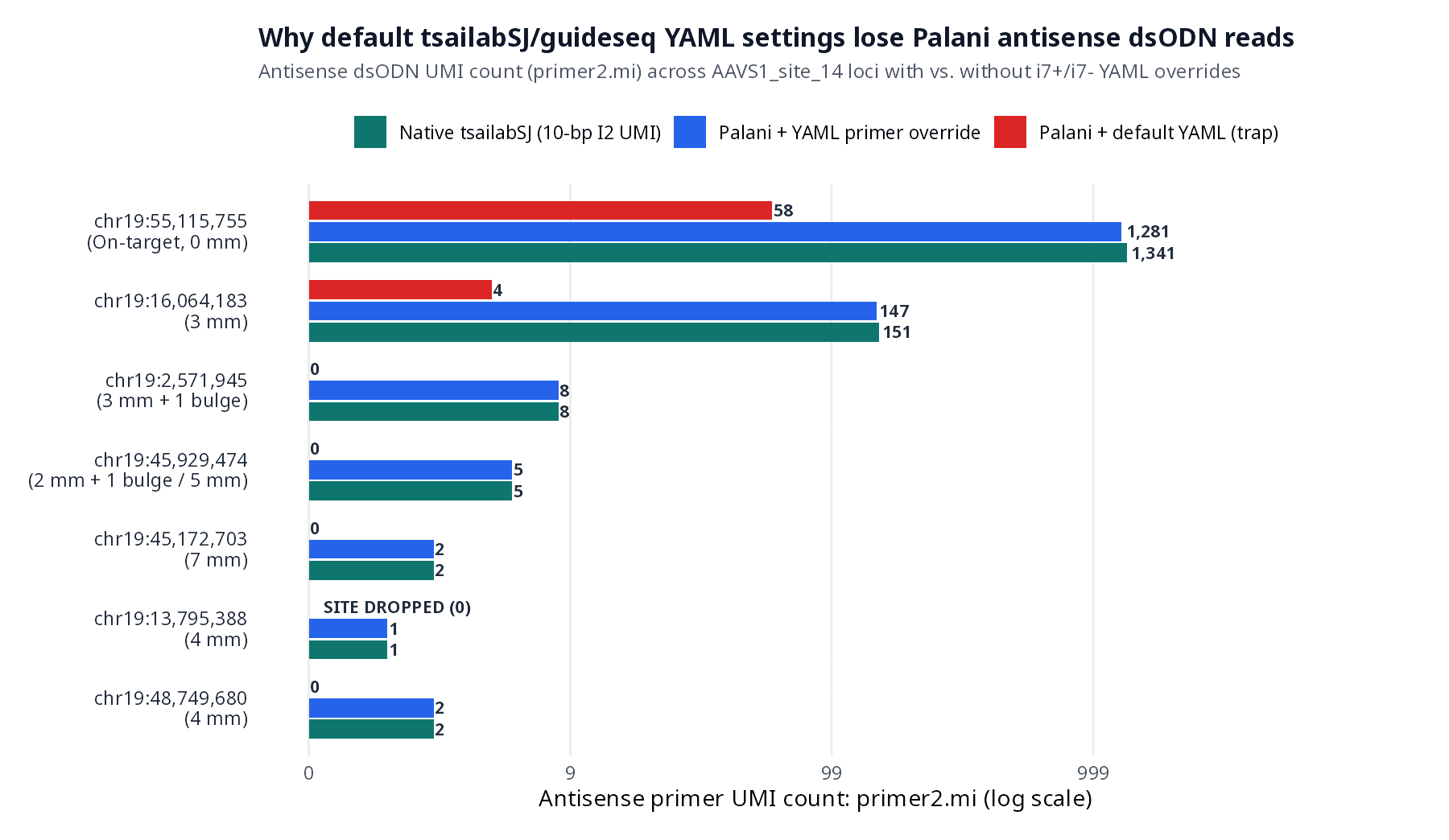
Figure 3. Impact of overriding i7+/i7- in tsailabSJ/guideseq when analyzing Palani protocols.io.wikfccw libraries. With the YAML primer override (blue), Palani recovers 95.5%–100% of native primer2.mi counts (teal) and all seven cleavage sites. Leaving default.yaml untouched (red) drops primer2.mi from 1,281 to 58 at the on-target site, zeroes out primer2.mi across minor off-targets, and completely loses the chr19:13,795,388 4-mismatch off-target (SITE DROPPED). Output of our comparative tsailabSJ/guideseq runs.
Two numbers in Figure 3 tell the whole story:
- With
palani_to_guideseq.py+ the YAML primer overrides, every single off-target locus matches the native 10-bp UMI run down to the single read (549vs.550,66vs.66,43vs.43,24vs.24,8vs.8,5vs.5), and the high-depth on-target site agrees to 99.84% (6,879vs.6,890UMIs — the 11-read difference is mild UMI collision saturation from an 8-bp UMI pool versus a 10-bp pool at a hotspot). - Without the YAML primer overrides,
primer2.miplummets from1,281to58at the on-target locus, drops to0at five off-target windows, and completely deleteschr19:13,795,388(4mismatches,+.mi = 8, -.mi = 0), because that site only had+strand alignments and relied onprimer.geometric_mean > 0(primer1.mi = 7,primer2.mi = 1) to survive window filtering!
Bench-design tip before you order Palani oligos: Notice that Palani's published
dsODN_Enrich_Minusprimer (5'-...NNN CCGTTATTAACATATGACAACTCAATTAAA*C-3') extends all the way to the 3' end of the antisense dsODN, leaving zero un-primered dsODN bases before genomic DNA! That works, as we just saw, if you overridei7+in YAML — but you lose V2's ability to verify residual dsODN sequence against antisense mispriming. When orderingdsODN_Enrich_MinusanddsODN_Enrich_Plus, shorten their 3' ends to match Tsai's nested endpoints (...NNN ATACCGTTATTAACATATGAC*Aand...NNN GTTTAATTGAGTTGTCATATGTTAATAA*C). You keep 100% of Palani's load-and-go Illumina workflow and keep V2's full 12-bp and 5-bp mispriming protection without needing primer overrides!
Two alternative software ecosystems for Palani / standard-Illumina data
If your team prefers R/Bioconductor or Snakemake over tsailabSJ/guideseq, two other open-source packages are worth knowing:
iGUIDE(Nobles et al., Genome Biology 2019;cnobles/iGUIDE): Built by Frederic Bushman's group at UPenn specifically for clinical T-cell editing workflows; its Snakemake configurations natively support Palani'sprotocols.io.wikfccwinline-UMI architecture and also support a longer 46-bp protected dsODN to sharpen mispriming discrimination.- Bioconductor
GUIDEseq+GS-Preprocess(Zhu et al., BMC Genomics 2017;umasstr/GS-Preprocess): Lihua Julie Zhu and Scot Wolfe's R/Bioconductor package offers flexible peak merging and multi-experiment Venn comparisons in R, paired withGS-Preprocess(docker.io/umasstr/gsp) to turn raw FASTQ/BCL files into plus/minus strand BAMs and UMI tables.
Head-to-head comparison: original vs. updated V2 vs. Palani simplified
| Feature | Original (aryeelab/guideseq) | Updated V2 (tsailabSJ/guideseq / GUIDE-seq-2) | Palani simplified (protocols.io.wikfccw + V2) |
|---|---|---|---|
| DNA fragmentation | Covaris acoustic shearing (~500 bp) | Covaris (2021) or single-tube UMI-Tn5 (2025) | Enzymatic one-pot (NEBNext Ultra II FS) |
| Adapter strategy | 16 custom barcoded Y-adapters | Barcoded Y-adapters or UMI-Tn5 transposome | 1 universal TA_Adaptor + standard Nextera PCR2 |
| UMI size & location | 8 bp inside I2 (16-bp Index 2 read) | 8–10 bp inside I2 (16–18 bp Index 2 read) | 8 bp inline at 5' start of Read 2 |
| dsODN junction read | Read 2 | Read 2 | Read 1 (must swap R1 ↔ R2 for guideseq.py) |
| Sequencer recipe | Custom 151 | 8 | 16 | 151 + raw I1/I2 | Custom I2 + raw undetermined FASTQs | Standard 2×150 dual-index (any core / NovaSeq) |
| Runtime stack | Python 2.7 (HTSeq, svgwrite) | Python 3.9 + UMI-tools / Docker | Python 3 (palani_to_guideseq.py) + V2 or iGUIDE |
| PCR deduplication | Pre-alignment FASTQ consensus | Post-alignment BAM (umi_tools dedup --paired) | Post-alignment BAM (umi_tools dedup --paired) |
| Residual dsODN mispriming | Not checked explicitly | Checked (GGTAT 5 bp / ACTCAATTAAAC 12 bp) | Supported (full 5/12 bp if 3' primers shortened) |
| ENCODE blacklist filtering | Manual | Built-in (hg38-blacklist.v2.bed.gz) | Built-in via tsailabSJ/guideseq |
| Best suited for | Reproducing 2015–2018 published datasets | High-throughput screening & dedicated MiSeq runs | Academic/biotech labs pooling onto standard lanes |
Limitations and caveats that no pipeline fixes
Getting your bioinformatics pipeline right ensures you don't invent false positives or throw away real dsODN integrations — but no software fixes the biological blind spots of the GUIDE-seq assay itself:
- GUIDE-seq is a candidate-discovery assay, not a measurement of indel rate. While
bi.sum.miranks cleavage sites roughly monotonically with cutting activity, dsODN capture efficiency varies by locus, repair pathway balance (NHEJ vs. MMEJ), and chromatin state. Every off-target nominated by GUIDE-seq still needs targeted validation by multiplexed amplicon sequencing (rhAmpSeq or two-step PCR) analyzed withCRISPResso2or CRISPECTOR in your actual target cells — see our amplicon NGS strategy guide for depth calculations (≥ 50,000reads per locus to detect0.1%editing). - dsODN toxicity in primary human stem cells and T cells. Double-stranded DNA oligonucleotides trigger cytosolic DNA sensors (cGAS-STING) and p53-mediated apoptosis in primary human hematopoietic stem and progenitor cells (HSPCs), primary T cells, and iPSCs. Because of that toxicity, many teams run discovery GUIDE-seq in permissive surrogate cell lines (U2OS, HEK293T, or K562) and validate hits in primary cells — which risks missing off-targets that sit inside open chromatin only in your primary lineage.
- Blind to non-DSB editors. Standard GUIDE-seq relies on blunt dsODN capture during NHEJ repair of double-strand breaks. It does not capture Cas9-independent deaminase off-targets from cytosine or adenine base editors, and its sensitivity drops sharply for nickase-based prime editors unless opposing nicks collapse into a DSB.
- Chromosomal translocations and large deletions aren't quantified by
bi.sum.mi. When a sample has a strong off-target likechr19:16,064,183alongsidechr19:55,115,755, simultaneous cleavage creates reciprocal translocations and kilobase-scale deletions. Notice line 365 of V2'sidentifyOfftargetSites.py(if abs(int(template_length)) > 10000: ... continue) writes distant/chimeric pairs to.tl_filter.tsvand excludes them from standard peak counts; you need dedicated assays (CAST-seq, PEM-seq, or AMP-seq) to measure structural rearrangements. - 8-bp UMI saturation at ultra-deep on-target peaks. At a single genomic nucleotide (
chr19:55,115,755) paired with enzymatically sheared fragments spanning ~300 start positions, an 8-bp UMI ( combinations) begins experiencing minor birthday-paradox collisions once a single peak exceeds several thousand molecules. Moving fromNNNNNNNN(8 bp) toNNNNNNNNNN(10 bp) when orderingTA_Adaptor_Topeliminates UMI collisions at zero extra sequencing cost.
Which GUIDE-seq workflow I'd pick today
If I'm setting up GUIDE-seq in a lab tomorrow, here is how I'd choose:
- Don't start new projects on
aryeelab/guideseq. Keep aguideseq_py27environment only if you're auditing historical 2015–2018 datasets. Between Python 2.7, 0-mismatch demultiplexing, thechrchrchromosome bug, and missing mispriming checks,tsailabSJ/guideseqV2 supersedes it in every way. - For 2 to 24 samples going to a core facility or commercial NovaSeq lane, use Palani's simplified wet-lab prep (
protocols.io.wikfccw) paired withpalani_to_guideseq.py+tsailabSJ/guideseqV2. Being able to fragment enzymatically with NEBNext Ultra II FS, use one universal adapter, and submit standard dual-indexed Illumina libraries saves thousands of dollars in custom oligos and dedicated MiSeq cartridges. Just make two tweaks when ordering oligos: bump the inline UMI inTA_Adaptor_Topfrom 8Ns to 10Ns (--umi-len 10), and pull back the 3' ends ofdsODN_Enrich_PlusanddsODN_Enrich_Minusto Tsai's nested endpoints (GTTTAATTGAGTTGTCATATGTTAATAACandATACCGTTATTAACATATGACA) so V2's residual-tag mispriming filter works at full strength. - For 48+ guides or population-scale specificity profiling, adopt GUIDE-seq-2 (UMI-Tn5 tagmentation) with
tsailabSJ/guideseqin Docker (liyc1989/tsailabsj). Once you're running full 96-well plates and controlling your own sequencing run configuration, dropping ligation and nested PCR1 in favor of one-step tagmentation pays back the setup effort on the very first plate.
Running GUIDE-seq on shared NovaSeq lanes with inline UMIs, or have you switched over to Tn5 tagmentation? Drop a comment below.
Resources
| Resource / Paper | What it provides | Link |
|---|---|---|
| Tsai et al. (Nat Biotechnol 2015) | Original GUIDE-seq cell-based off-target discovery paper | doi:10.1038/nbt.3117 |
| Tsai et al. (Nat Biotechnol 2016) | Companion paper describing the original open-source guideseq Python package | doi:10.1038/nbt.3534 |
aryeelab/guideseq | Original Joung/Aryee 7-step GUIDE-seq pipeline repository | github.com/aryeelab/guideseq |
| Malinin et al. (Nature Protocols 2021) | Detailed step-by-step bench and computational GUIDE-seq protocol | doi:10.1038/s41596-021-00626-x |
tsailabSJ/guideseq (V2) | Actively maintained Python 3 GUIDE-seq / GUIDE-seq-2 analysis pipeline | github.com/tsailabSJ/guideseq |
| Lazzarotto et al. (bioRxiv 2025) | Preprint introducing Tn5 tagmentation-based GUIDE-seq-2 and CHANGE-seq-R | doi:10.1101/2025.02.10.637517 |
| Palani N. (protocols.io) | Simplified GUIDE-seq library prep with enzymatic shearing and inline Read 2 UMIs | doi:10.17504/protocols.io.wikfccw |
| Zhu et al. (BMC Genomics 2017) | Bioconductor GUIDEseq R package paper (source of Figure 1, CC BY 4.0) | doi:10.1186/s12864-017-3746-y |
| Nobles et al. (Genome Biology 2019) | iGUIDE Snakemake pipeline (cnobles/iGUIDE) supporting wikfccw inline UMIs | doi:10.1186/s13059-019-1625-3 |
umasstr/GS-Preprocess | Containerized preprocessor bridging standard Illumina BCL/FASTQ to GUIDEseq | github.com/umasstr/GS-Preprocess |
Keep reading
Understanding CRISPR amplicon sequencing reads: what your FASTQ files actually tell you
Your amplicon sequencing data just landed in your inbox as a folder of .fastq.gz files. Before you run any CRISPR analysis tool, here's how to check the run is any good, using a real MiSeq dataset with an untreated control, an edited sample and one failed library.
Measuring CRISPR editing efficiency from start to finish: a complete protocol overview
Your T7E1 gel says 37% editing, your Sanger trace in ICE says 58%, and your single-cell clone looks completely unedited on the gel even though the protein is gone. Here is the end-to-end bench and analysis protocol for measuring CRISPR efficiency across knockouts, base edits, prime edits, and HDR knock-ins without getting fooled by your assay.
CRISPResso2: the standard tool for CRISPR NGS analysis (full tutorial)
Your amplicon FASTQ files are back from the sequencer, and the default CRISPResso2 numbers are already lying to you about your HDR and base editing rates. Here is how to run CRISPResso2 properly from raw paired-end reads to publication-ready allele tables.