- Published on
- 9 min read
Designing pegRNAs for prime editing: principles and tools
- Authors

- Name
- BioTech Bench
Table of contents
This is Arc 1, Part 7 of the CRISPR from Bench to Analysis series.
You know prime editing can make your edit. Now you need a pegRNA. This is where most people get stuck: a pegRNA has five distinct design parameters, and getting any one wrong tanks efficiency. Unlike standard gRNA design — where spacer selection and PAM finding are the main decisions — pegRNA design requires you to specify the RT template, the PBS, the nick guide, and check for secondary structure.
This post explains the logic behind each parameter, then shows how to use PrimeDesign to apply them.
What you'll learn
- The four parts of a pegRNA and what each does
- PBS length: why 10–13 nt is optimal and how to count it
- RT template length: the trade-off between coverage and secondary structure
- Nick site distance: how to place the edit within the RTT
- Secondary structure: why 3′ extension folding kills efficiency and how to check it
- PE3 nicking guide: when to add it and the 40–90 nt distance rule
- How to use PrimeDesign to generate and rank pegRNA candidates
Anatomy of a pegRNA
A standard gRNA has two parts: a ~20 nt spacer that directs Cas9 to the right genomic location, and a scaffold that holds the complex together. A pegRNA has two additional components, added as a 3′ extension to the scaffold: an RT template (RTT) and a primer binding site (PBS).
Here's how they work together: after nCas9 binds and nicks the non-template strand, it creates a free 3′ end in the genomic DNA. That 3′ end hybridises to the PBS on the pegRNA. The reverse transcriptase — fused to nCas9 — then reads the RTT and synthesises a new DNA strand that incorporates your edit. The result is a 3′ flap containing the edit, which gets incorporated into the genome through flap equilibration and mismatch repair.
If you need a refresher on the full mechanism, CRISPR-4 covers it in detail. This post is about the design parameters.
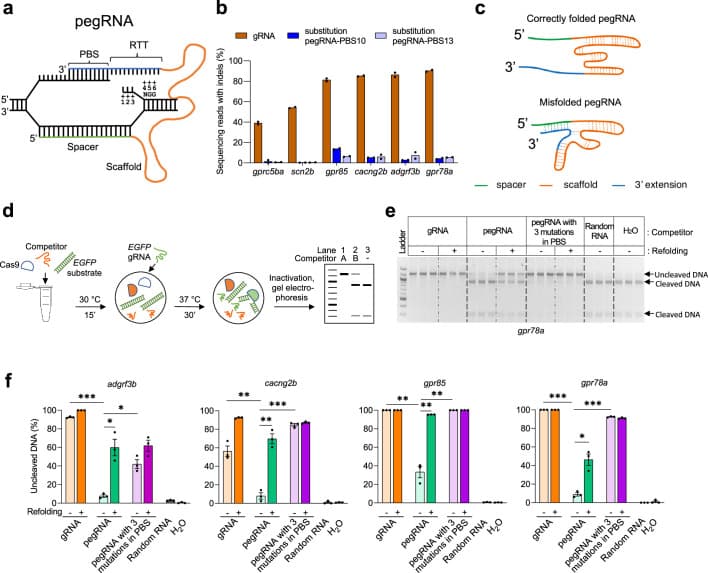
Figure 1. Schematic of a pegRNA showing the four structural components: spacer (targeting sequence), sgRNA scaffold, RT template (RTT, encoding the desired edit), and primer binding site (PBS, hybridising to the nicked genomic strand). Adapted from Zhang W et al. (2024). Increasing the efficiency and precision of prime editing with guide RNA pairs. eLife, 12:RP90948. doi:10.7554/eLife.90948, under CC BY 4.0.
Design principle 1 — PBS length
The PBS is what anchors the free genomic 3′ flap to your pegRNA. Too short (≤8 nt) and the hybridisation is unstable — the flap falls off before the RT can extend it. Too long (≥16 nt) and the RT tends to stall, or the pegRNA becomes too rigid for efficient use.
The sweet spot is 10–13 nt. To find your PBS: identify the nick site (3 bp upstream of the PAM), then take the next 10–13 bases moving toward the protospacer. Those bases, taken in the reverse complement, are your PBS sequence.
GC content matters here too. Aim for ~40–50%. A PBS that's mostly AT will have weak hybridisation; mostly GC raises the risk of G-quadruplex formation. Avoid runs of four or more G bases.
Design principle 2 — RT template length
The RT template encodes your edit plus the flanking sequence that needs to match the genome on the non-PAM side. Two rules:
- The edit must fall within the RTT — not before the nick site, not past the end of the template
- The RTT must extend at least 3 nt past the edit on the non-PAM side
In practice, 10–20 nt covers most edits. Shorter RTTs carry less secondary structure risk; longer RTTs give the RT more room to work and tolerate minor mismatches at the edit site. Avoid placing your edit at positions 1–3 of the RTT (the end closest to the nick) — efficiency drops sharply there. Positions 4–14 are optimal.
If your target edit is far from any available PAM, you'll need a longer RTT to reach it, which increases secondary structure risk. This is often the constraint that forces you to look for a different spacer.
Design principle 3 — Nick site and edit placement
nCas9 nicks the non-template strand 3 bp upstream of the PAM. Your edit must land within the RTT window — between the nick and the end of the RTT. If you can't achieve this with any PAM in the region, try the opposite strand: flipping the spacer orientation gives you a different set of nick sites and often places the edit in a better RTT position.
A useful check before running PrimeDesign: scan for PAMs (NGG for SpCas9) on both strands within ~30–50 bp of your target edit. Any PAM that puts the edit between positions 4 and 14 of a 10–20 nt RTT is a good candidate spacer to design around.
Design principle 4 — Secondary structure
The 3′ extension (RTT + PBS combined) is an RNA sequence hanging off the end of your pegRNA scaffold. If it folds back on itself — or worse, base-pairs with the scaffold — the pegRNA cannot function. The reverse transcriptase needs a single-stranded template; a hairpin at the 5′ end of the extension (near the scaffold junction) blocks access entirely.
PrimeDesign calculates a predicted ΔG for the 3′ extension folding. Treat any value more negative than −8 kcal/mol as a warning flag. You can also check manually using the RNAfold web server — paste the 3′ extension sequence and look for stem-loops near its 5′ end.
If all your candidates have problematic folding, the most effective fix is switching to a different spacer. A slightly different nick site changes the RTT and PBS sequences, which usually resolves the structural problem without requiring you to compromise on PBS or RTT length.
Design principle 5 — PE3 nicking guide
PE2 uses only the pegRNA. PE3 adds a second nicking guide on the opposite strand, nicking ~40–90 nt from the pegRNA nick site. This forces the cell to use your edited strand as the repair template rather than the original unedited sequence, boosting efficiency 3–5× in many cell types.
The distance constraint is firm: 40–90 nt from the pegRNA nick. Closer than 40 nt and the two nicks together form a functional double-strand break — you get indels from NHEJ rather than the precise edit you wanted. Further than 90 nt and the efficiency gain disappears.
PE3b is the smarter variant. The PE3 nicking guide is designed so that its PAM site is disrupted by the edit itself. This means the PE3 guide can only nick after successful prime editing has occurred — it won't nick unedited alleles. The result is a cleaner outcome with fewer unwanted indels. PE3b is particularly useful when your edit happens to modify an NGG PAM in the region 40–90 nt from the pegRNA nick.
Using PrimeDesign
Go to primedesign.hms.harvard.edu.
Paste ~200 nt of genomic sequence centred on your target site. Specify your edit using bracket notation within the sequence: [original/edit]. For a single-base A→G transition, mark the target A as [A/G]. For a 3-bp deletion, use [ACTG/G].
PrimeDesign returns a ranked table of pegRNA candidates. Each row includes:
| Column | What to look for |
|---|---|
| PBS length | Filter to 10–13 nt |
| RTT length | Filter to 10–20 nt |
| Edit position in RTT | Should be ≥ 4 |
| 3′ extension ΔG | Flag if < −8 kcal/mol |
| Rank score | Higher = predicted better efficiency |
| PE3 guide options | Check for 40–90 nt offset; prefer PE3b if available |
Start with the top-ranked candidates that pass the PBS and RTT length filters. The rank score integrates secondary structure, edit position, and PBS/RTT parameters — it's a reasonable starting point, but always apply manual filters on top of it.
Order at least 2–3 pegRNAs per target. Efficiency varies substantially between candidates in the same region, and testing one pegRNA before concluding that prime editing doesn't work for your target is one of the most common mistakes in the field.
My take
PrimeDesign is the right first tool. It's free, web-based, and the ranking algorithm is well-validated across diverse targets. What it can't tell you is how your specific cell type will respond — PE2 efficiency ranges from less than 1% to over 40% for the same target depending on cell type, chromatin accessibility, and MMR activity.
If you're consistently below 5% efficiency despite good pegRNA design, the next step is the epegRNA scaffold modification: adding an engineered 3′ motif (the tevopreQ1 or evopreQ1 pseudoknot) to the end of the PBS. This stabilises the 3′ extension and substantially improves efficiency in difficult targets. epegRNAs are available as plasmids from Addgene for the main PE variants, and commercial providers now synthesise them directly.
Have you run into a pegRNA that just wouldn't work? Drop a comment below — would love to hear what the issue turned out to be.
Resources
| Resource | Link | Notes |
|---|---|---|
| PrimeDesign (web) | primedesign.hms.harvard.edu | Free pegRNA design — start here |
| Hsu JY et al. (2021) | doi:10.1038/s41587-020-0677-y | PrimeDesign paper (Nature Biotechnology) |
| Nelson JW et al. (2022) | doi:10.1038/s41587-021-01039-7 | epegRNA paper (Nature Biotechnology) |
| RNAfold web server | rna.tbi.univie.ac.at | Secondary structure prediction |
| Zhang W et al. (2024) | doi:10.7554/eLife.90948 | Figure 1 source (eLife, CC BY 4.0) |
| CRISPR-4: Prime editing | /blog/prime-editing-how-it-works-vs-cas9 | Mechanism background for this post |
Keep reading
In silico off-target prediction: how the algorithms work and which tools to trust
Choosing a guide RNA that cuts your target is only half the battle. You also need one that doesn’t cut anywhere else. This post breaks down the MIT and CFD scoring systems, how off-target algorithms actually work, and which tools are best for predicting Cas9 and Cas12a off-targets.
On-target assessment methods compared: T7E1, TIDE, and amplicon NGS
You’ve made your edit, but how much of it is actually there? This post compares the three most common ways to measure CRISPR on-target efficiency—from the "quick and dirty" T7E1 gel assay to the high-resolution precision of Amplicon NGS.
Choosing your CRISPR system and designing validated guides: an end-to-end walkthrough
You have a gene to edit. Should you use Cas9, Cas12a, or a Base Editor? This capstone post walks you through the entire workflow—from choosing the right molecular "scissors" for your target to designing and validating your final guides.