Six steps from raw CSV to a publication-ready figure with significance bars. A complete, copy-paste-ready R workflow using dplyr, ggplot2, and ggsignif — built on the qPCR dataset from Arc 1.
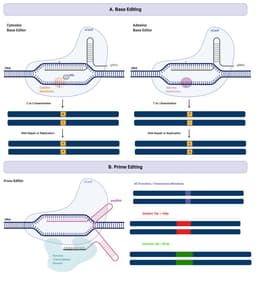
Prime editing writes any small edit directly into your genome — transversions, insertions, deletions — without cutting both DNA strands. This post covers the mechanism, PE2/PE3/PE7 variants, and when to choose prime editing over base editing or HDR.
t.test() and aov() replace ten minutes of clicking in GraphPad Prism. Here is how to run t-tests, ANOVA, and post-hoc comparisons on your qPCR data — with code you can actually reproduce.
Base editing converts a single nucleotide directly — no double-strand break, no donor template — with efficiencies that routinely outperform HDR in primary and non-dividing cells. This post covers how CBE and ABE work, the editing window, bystander edits, and when to choose base editing over Cas9+HDR or prime editing.